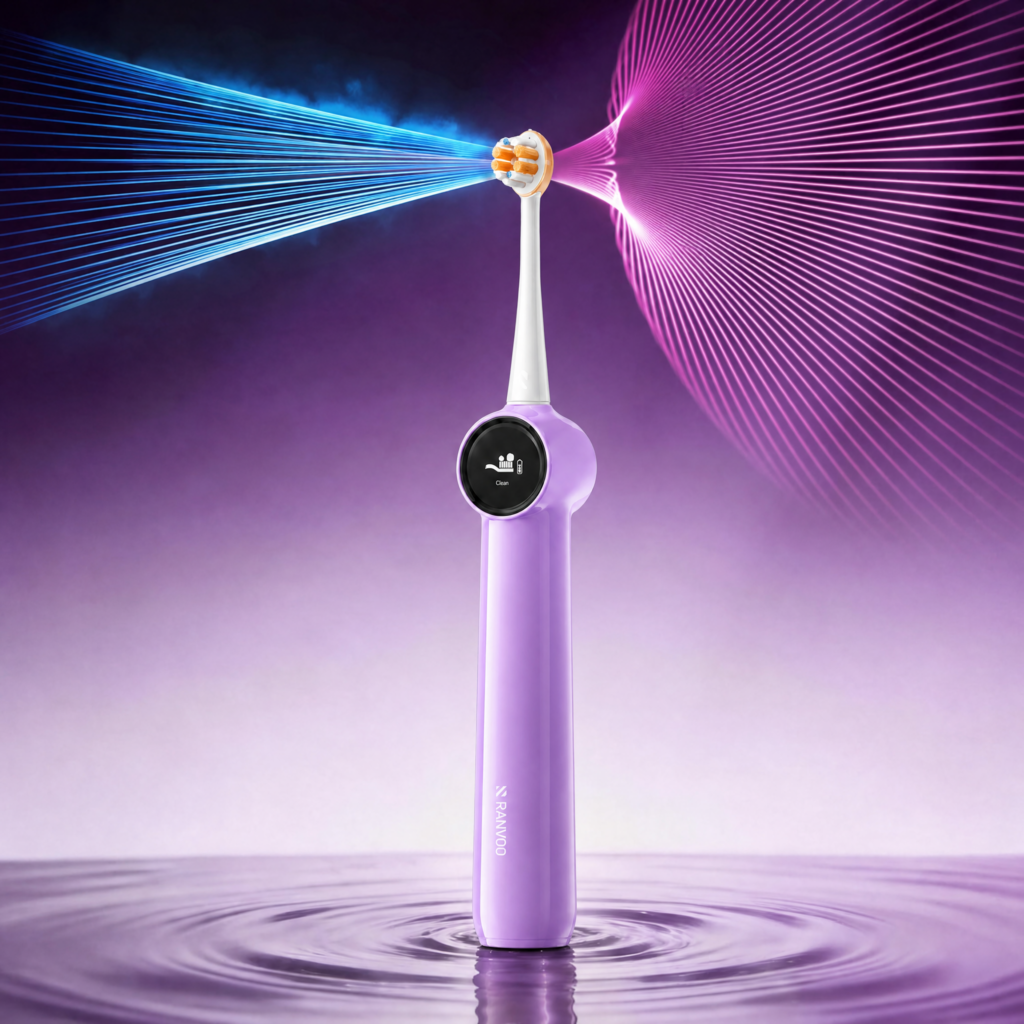
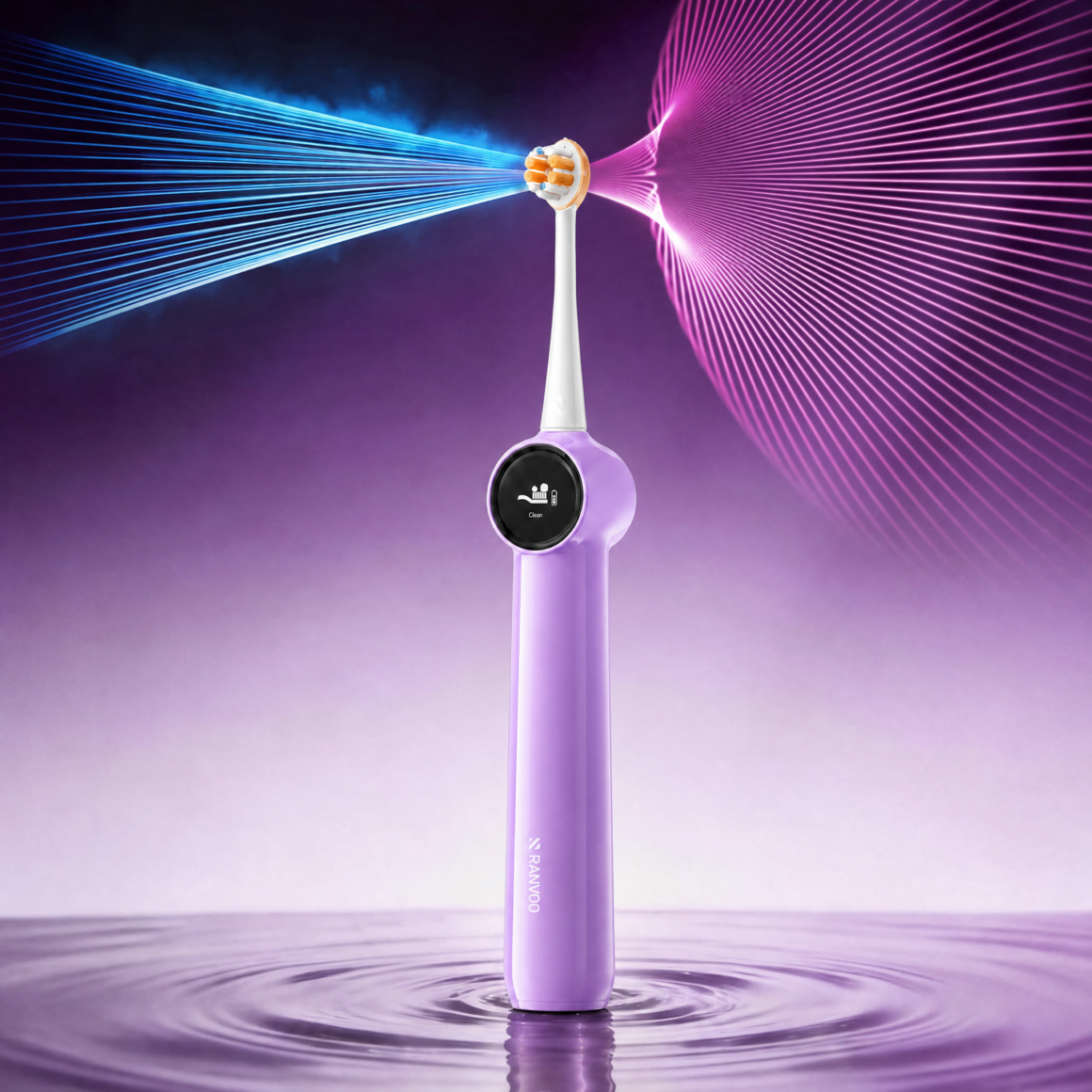
Most will point you toward brushes with “sensitive” modes, soft bristle heads, or pressure sensors that light up when you press too hard.
The Search for a Gum-Safe Electric Toothbrush
Type “electric toothbrush for gum care” into any search engine, and you will find hundreds of results. Most will point you toward brushes with “sensitive” modes, soft bristle heads, or pressure sensors that light up when you press too hard. These features are well-intentioned. They are also, in most cases, superficial accommodations bolted onto a cleaning mechanism that is fundamentally hostile to gingival tissue.
The uncomfortable reality is that the electric toothbrush category was never designed with gum health as a primary objective. It was designed to remove plaque from tooth surfaces — a goal it pursues with escalating mechanical intensity. Higher frequencies. Wider oscillation arcs. Denser bristle fields. Gum care, in this framework, has always been an afterthought: a “sensitive mode” that slightly reduces power, a softer brush head sold separately, a pressure sensor that scolds you after the damage is already underway.
A genuine electric toothbrush for gum care cannot be produced by dialing down an inherently gum-aggressive design. It requires rethinking the relationship between the cleaning mechanism and the tissue it is meant to protect — from first principles, at the architectural level. This is what distinguishes incremental accommodation from genuine innovation, and it is the standard against which any electric toothbrush claiming gum-care credentials should be measured.
What Gums Actually Need From a Toothbrush
To evaluate whether an electric toothbrush genuinely serves gum health, it helps to understand what gingival tissue requires — and what it cannot tolerate.
Human gums are composed of masticatory mucosa: a layer of keratinized stratified squamous epithelium overlying a lamina propria rich in collagen fiber bundles and blood vessels. This tissue is resilient but not indestructible. Its primary vulnerabilities to brushing are threefold.
First, compressive stress. Every bristle that strikes the gingival margin delivers a concentrated mechanical impulse to epithelium that is, at most, a few hundred microns thick. Multiply this by the stroke frequency of a typical sonic brush — 31,000 to 62,000 impacts per minute — and the tissue is subjected to over a thousand discrete compressive events per second. Over a two-minute brushing session, the cumulative mechanical load exceeds what the epithelial barrier is evolutionarily equipped to handle. The result is micro-trauma, inflammation, and over time, apical migration of the gingival margin — recession.
Second, shear stress at the junctional epithelium. The junctional epithelium is a specialized, non-keratinized tissue that forms a biological seal between the gum and the tooth surface. It is attached to enamel via hemidesmosomes and a basal lamina — molecular structures that are exceptionally vulnerable to lateral displacement forces. Wide-amplitude brush head oscillations generate precisely this type of shear, repeatedly tugging at the epithelial attachment. Once the junctional epithelium detaches and migrates apically, the underlying connective tissue and alveolar bone are exposed to bacterial infiltration — the initiating event in periodontitis.
Third, abrasive wear from bristle tips. Not all bristles are created equal. Under microscopic examination, many brush heads — particularly those manufactured to lower cost targets — reveal bristle tips that are irregularly cut, jagged, or sharply angled. Each of these microscopic irregularities functions as an abrasive point on soft tissue. Even bristles that appear smooth to the naked eye can, at the cellular scale, create micro-lacerations that provoke an inflammatory response.
A toothbrush that genuinely protects gums must address all three of these vulnerabilities. It must reduce compressive load, minimize shear stress at the epithelial attachment, and ensure that every bristle tip presents a hemispherical, non-abrasive contact surface. These are not features that can be added to an existing design; they are constraints that must shape the design from the outset.
Why Most “Gum Care” Modes Fall Short
The industry’s standard approach to gum care is the “sensitive” or “gum health” mode — a setting that typically reduces motor power by a fixed percentage, shortens the quadrant timer, or both. On closer inspection, these modes reveal themselves as largely cosmetic.
Reducing motor power lowers stroke amplitude but typically leaves frequency unchanged. A brush oscillating at 40,000 strokes per minute at 80% power still delivers 40,000 impacts per minute to the gum line; each impact is simply somewhat weaker. The fundamental problem — that bristles are striking gingival tissue at a rate measured in kilohertz — remains unaddressed.

Pressure sensors, another common gum-care feature, suffer from a different limitation: they are reactive, not preventive. By the time a pressure sensor illuminates, excessive force has already been applied. For users with existing gum sensitivity, that single excessive stroke may be enough to provoke bleeding. Moreover, pressure sensors address only the force of the stroke, not its frequency or the quality of the bristle tip performing it. They are a safety net, not a safety system.
The deeper issue is architectural. Conventional electric toothbrushes rely on bristle contact for all cleaning — surface and interdental alike. As long as interdental cleaning depends on mechanical bristle penetration, the system cannot reduce frequency or amplitude below a threshold without sacrificing cleaning efficacy. Gum care becomes a zero-sum trade-off: less trauma means less clean. This trade-off is accepted as inevitable by most of the industry. It is not.
AirJet and the Decoupled Cleaning Architecture
RANVOO’s approach begins by asking what would happen if interdental cleaning — the task that demands the most from bristles and generates the most gingival trauma — were removed from the bristle system’s responsibilities entirely.
The answer is the AirJet decoupled cleaning architecture. Two separate mechanisms share the cleaning workload, each optimized for its specific domain, with no forced compromise between them.
Surface cleaning remains the domain of bristles. Freed from the impossible task of penetrating sub-millimeter interdental gaps, these bristles can be designed purely for gentle, effective facial and lingual surface maintenance. AirJet bristle tips measure 0.01 mm in diameter and undergo a polishing process that achieves a 99.99% end-rounding rate — verified to ensure every filament presents a smooth hemispherical contact surface. There is no justification, in a gum-care context, for bristles that have not been subjected to this level of quality control. The irregular bristle layout improves contact with uneven tooth surfaces without increasing pressure or adding harshness.
Interdental cleaning is assigned to cavitation — a fluid-dynamic, non-contact mechanism. A Boosted Bubble Chamber inside the handle aerates the water-toothpaste mixture into a continuous stream of high-density microbubbles. These bubbles, tens of microns in diameter, are propelled by a Coanda Bubble Brush Head that automatically directs fluid flow along tooth contours and into interdental spaces. When the microbubbles reach plaque biofilm in the confined gaps between teeth, they undergo acoustic cavitation: asymmetric collapse that produces localized high-velocity microjets capable of physically dismantling plaque’s extracellular matrix and detaching it from the tooth surface. This entire process occurs without a single bristle entering the interdental space — and therefore without a single bristle contacting the gingival papilla, the triangular gum tissue that fills the space between teeth and is among the most vulnerable structures in the oral cavity.
The Gum-Protection Parameters, Quantified
The decoupled architecture enables specific, measurable reductions in mechanical stress on gingival tissue.
AirJet operates at a maximum frequency of 21,600 strokes per minute — approximately one-half to one-third the frequency of leading sonic brushes. At this reduced stroke rate, the daily mechanical impact load on the gingival margin is substantially lower, while surface cleaning remains fully effective thanks to optimized bristle design and the non-contact interdental mechanism.
The 12° micro-oscillating sweep limits lateral bristle displacement. Narrower oscillation means less tugging on the junctional epithelium, the specialized attachment tissue whose degradation is the starting point for gum recession. Testers consistently report that the brushing sensation feels less like vibration and more like a gentle massage — a subjective experience that reflects an objective reduction in shear stress.
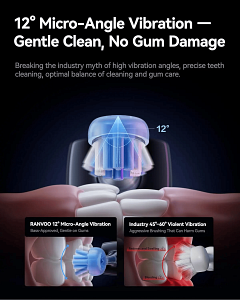
In Sensitive Mode, the fluid flow rate drops to 500 ml/min — half the maximum — while amplitude shifts to a gentler 3.0–4.5 mm range. This combination reduces both cavitation intensity and mechanical stimulation at the bristle-tissue interface. The mode is designed for users with active gingivitis, those in post-procedure recovery, and anyone managing persistent gum sensitivity or recession. It delivers meaningful cleaning without exacerbating soft-tissue compromise.
The brush head backing is coated in TPE (thermoplastic elastomer) rubber, a shock-absorbing layer that eliminates the hard-plastic-to-tooth contact responsible for the jarring “chattering” sensation common to conventional brush heads. This detail, easy to overlook on a specification sheet, has an outsized impact on daily comfort — particularly for users whose gums are already tender or inflamed.
Beyond the Brush Head: Hygiene as Gum Protection
Gum health extends beyond what happens during the two-minute brushing window. A toothbrush that harbors bacteria, mold, or fungal colonization between uses becomes a vector for reintroducing pathogens to the gingival margin at every subsequent session. This is particularly concerning for users with existing periodontal vulnerability.
AirJet addresses this through a SiC anti-mold coating applied to both the handle and the magnetic wall mount. The coating achieves Grade 0 anti-mold certification — the highest standard — actively inhibiting microbial colonization on device surfaces. The magnetic wall mount serves a dual purpose: it stores the brush off the counter, eliminating the pooled water that breeds bacteria around conventional charging bases, and it functions as a wireless charger, ensuring the brush is always powered without the hygiene compromise of a wet charging cradle.
What “Electric Toothbrush for Gum Care” Should Mean
The phrase “electric toothbrush for gum care” has been diluted by marketing departments to the point of near-meaninglessness. It is applied to brushes whose sole gum-care credential is a slightly softer brush head, a power-limiting mode that changes little, or a pressure sensor that alerts after the fact.
A meaningful standard for gum-care claims would require answers to a set of specific, testable questions. What is the operating frequency, and is it low enough to avoid cumulative micro-trauma to the gingival margin? Are the bristle tips verified to a measurable end-rounding standard, and if so, what is that standard? Does the brush clean interdentally, and if so, does that cleaning depend on forcing bristles into spaces they were never designed to enter? Is the cleaning mechanism architecturally decoupled — can interdental cleaning be achieved without bristle penetration, thereby freeing the bristle system to prioritize tissue safety?
For most electric toothbrushes on the market, honest answers to these questions would be uncomfortable. For AirJet, they are the design specification.
A Category Correction
The electric toothbrush industry did not set out to damage gums. But its century-long commitment to a single cleaning mechanism — bristle friction — created a structural incentive toward ever-greater mechanical intensity, and gum protection was the variable sacrificed along the way. Sensitive modes, pressure sensors, and soft brush heads are patches applied to a system whose fundamental architecture works against the tissue it claims to protect.
An electric toothbrush built genuinely for gum care starts from a different premise: that cleaning and comfort are not opposites to be balanced, but outcomes to be aligned. AirJet aligns them by giving bristles less to do — and by handing the hardest cleaning task, interdental plaque removal, to a mechanism that does not touch gums at all. That is not a feature. It is the only architecture that makes gum-first design possible.