The majority of Americans are able to continue playing cards — particularly poker — either by traveling to the nearest casino or by using online services. However, like many things in America, the ability for residents to use online poker sites (where individuals may bet money) varies greatly from state to state. Like many forms of gaming in America, there are limited options when compared to gambling activities such as sports wagering, which became a legal form of entertainment for nearly all of America after the U.S. Supreme Court ruled that states could permit and regulate sports wagering.
Where Regulated Online Poker Operates Today
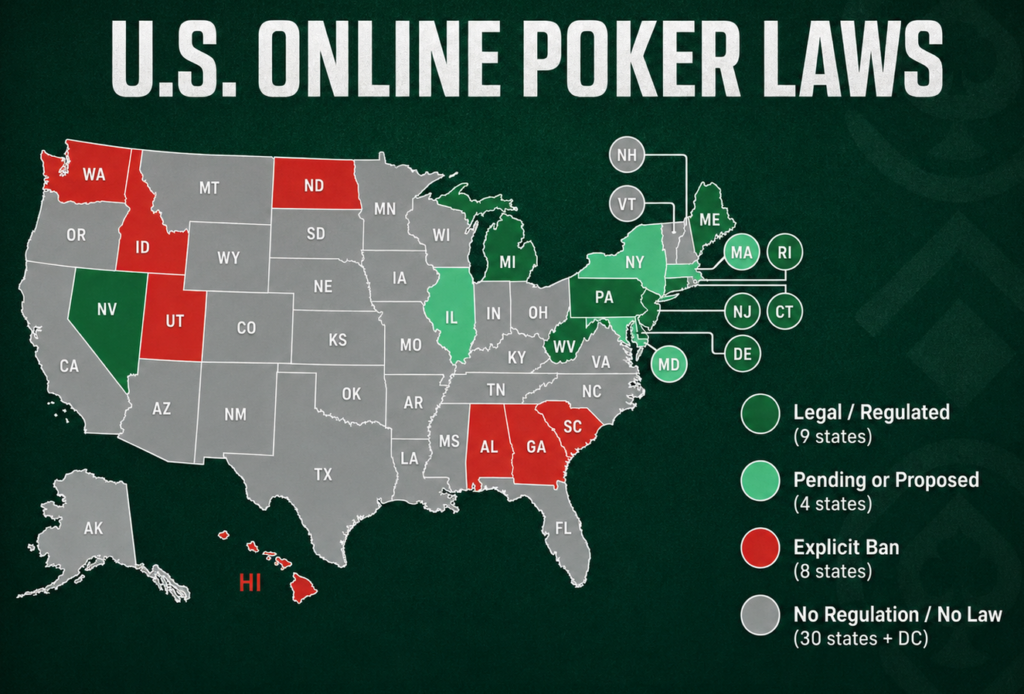
Currently, only six states have active, licensed real-money online poker sites: Delaware, Michigan, Nevada, New Jersey, Pennsylvania, and West Virginia. Nevada, Delaware, and New Jersey provided the opportunity to gamble online beginning in 2013. Pennsylvania and West Virginia followed suit shortly thereafter. Michigan permitted the practice in late January 2021. Several of those states share players through a Multi-State Internet Gaming Agreement. Through this agreement, the companies providing internet gaming services are allowed to share player pools. This allows them to keep tables filled beyond their own individual peak usage periods.
Some examples of recognizable brands that offer poker services in these states include WSOP.com, BetMGM Poker, PokerStars and BetRivers Poker. It is worth noting that there are some brands that are licensed in certain states while others are not. Connecticut, Rhode Island and Maine have passed laws permitting online poker services. However, none of those states have yet brought online poker providers into their respective markets. All players who access online poker services via a computer or mobile device must prove they are physically present in one of the states that permits online poker service providers. Geolocating technology verifies the player’s location each time the player attempts to log onto an online poker site.
The fragmented landscape traces back to how gambling law works in the US. Each state regulates its own betting and gaming activity, and there is no federal law authorizing or coordinating online poker nationwide. That leaves expansion entirely up to individual state legislatures, which helps explain why progress has moved so unevenly — a bill can stall in committee for years in one state while a neighboring state legalizes and launches a market within a single session.
What Players Elsewhere Rely On
Outside of that group of states, options become very limited. In many states without licensed online poker, some players turn to sweepstakes-style platforms, although availability and legal scrutiny vary significantly by state. Sweepstakes sites are available in almost every state, even those states with no viable means of obtaining an online poker license.
Offshore poker sites that operate from jurisdictions outside of the United States represent another category. Examples include Bovada and other offshore poker sites operating in a legal gray area of their own, and because they are located outside of the United States, they cannot provide consumers with the level of protection provided by regulated U.S.-based sites. Accessible U.S. locations are subject to change, therefore it’s always best to confirm the availability of specific sites prior to making a deposit. Additionally, deposits typically run through cryptocurrency rather than traditional banking methods, because UIGEA restricts payment processing connected to unlawful internet gambling, offshore operators often rely on alternative payment routes, including crypto.
Maryland’s Poker Scene Stays Land-Based
Maryland does not permit online poker or online casino-style gaming as of mid-2026. There have been multiple legislative efforts over the years to legalize online gaming in Maryland, however none have passed to date. This past spring, the latest attempt — a bill that would have allowed for online gaming and then asked voters if they wanted the opportunity to gamble online via ballot initiative — was pulled by its author in the Maryland Senate prior to receiving a vote on the Senate floor. It is anticipated that legislators will reintroduce similar legislation during the 2027 legislative session.
In the meantime, MD poker enthusiasts are relegated to playing live poker at various casino properties throughout the state. One of the largest live poker room facilities in the eastern half of the United States is located at Live! Casino & Hotel in Hanover.
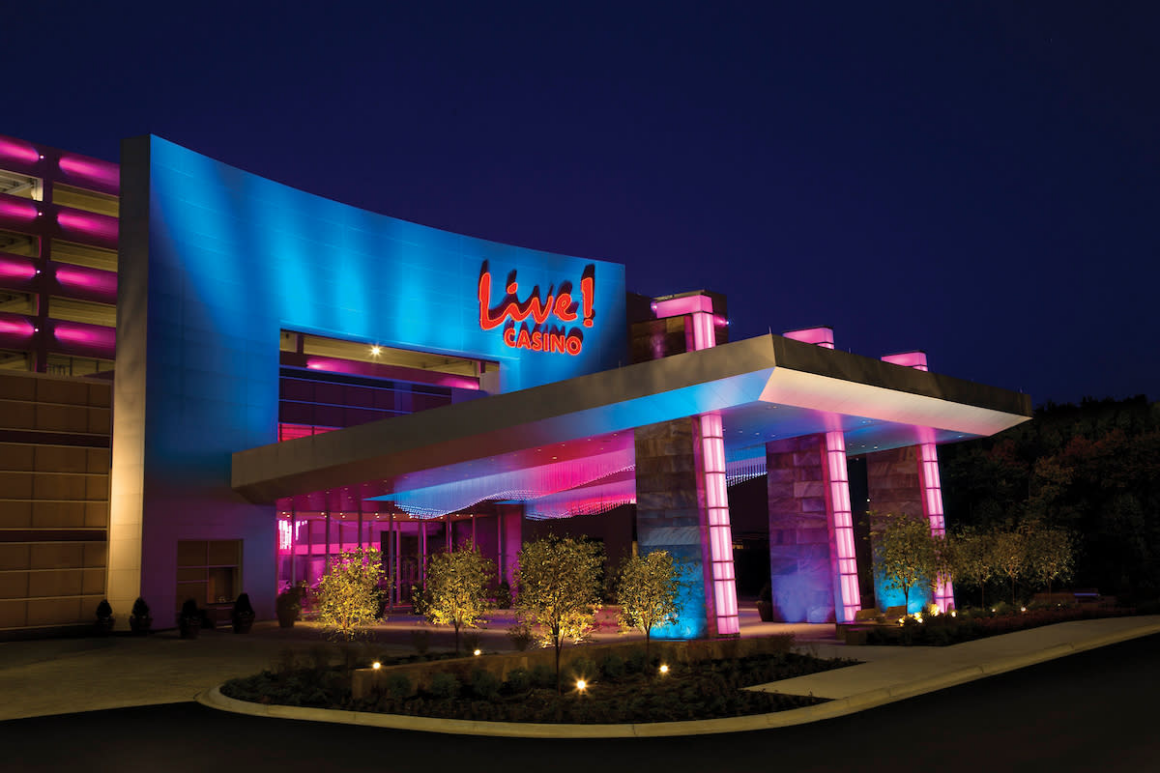
That facility features a large number of table spaces — approximately 50 — spread over two floors. While there may be fewer opportunities for Maryland-based players to participate in live poker compared to Las Vegas or Atlantic City, many casinos within the state offer some form of live poker action although often on a much smaller scale than Live!. Also, a few Maryland players have opted to use sweepstakes sites but they are currently being scrutinized by Maryland gaming officials who have sent cease and desist orders to numerous sweepstakes site operators in the past year. A separate bill aimed at banning the sweepstakes model outright advanced further in the 2026 legislative session than the online gaming proposal did, adding even more uncertainty for players who had been leaning on that option as a workaround.
Across the country, legal status for online poker depends less on the game itself and more on where you live. A small cluster of states offers fully licensed platforms and a slightly larger group is still developing its regulatory framework. Most of the rest of the US relies on sweepstakes sites, rooms overseas or simply at land casinos. Maryland right now falls into that last category and whether that changes will depend on what lawmakers in Annapolis decide to do about the issue again.