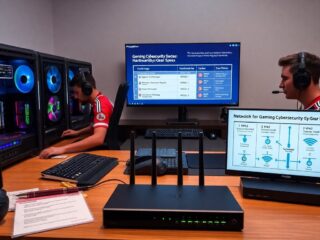
Gaming cybersecurity gear specs progeekflow sets standards for secure play. ProGeekFlow lists hardware, network, and software rules. The guide targets competitive gamers who want low lag and safe accounts. Each rule states a spec or action. Readers learn what to buy and how to configure gear for tournaments and ranked play.
Key Takeaways
- Gaming cybersecurity gear specs progeekflow emphasize multi-core CPUs with secure boot features to ensure low lag and firmware protection.
- A minimum of 32 GB RAM and NVMe SSDs with hardware encryption optimize performance and safeguard saved data for competitive gamers.
- Secure peripherals like wired keyboards and headsets with mute functions reduce interception and audio leaks during tournaments.
- ProGeekFlow advises dual-router networks with WPA3, VPN passthrough, and VLAN segmentation to protect gaming sessions from attacks and maintain performance.
- Use password managers with hardware-backed keys, multifactor authentication, and approved anti-cheat software to secure gaming accounts and systems.
- Regular encrypted backups, strict account hygiene, and team security protocols minimize downtime and maintain competitive integrity.
Essential Hardware Specs For Secure High-Performance Gaming
ProGeekFlow lists core hardware that protects performance and accounts. The guide starts with the CPU. It recommends a multi-core CPU with high single-thread clocks to reduce frame drops. Gamers should choose processors that include secure boot and firmware signing features. ProGeekFlow labels these features as low-level protections against tampered firmware and rootkits. The phrase gaming cybersecurity gear specs progeekflow appears as a reference for these CPU requirements.
ProGeekFlow then specifies memory and storage. It calls for at least 32 GB of RAM for streamers and competitive players who run background security tools. It asks for an NVMe SSD with hardware encryption support for fast loads and safe local data. The guide notes that encrypted storage keeps saved passwords and config files safer if a device is lost.
The GPU section focuses on driver security and thermal headroom. It tells users to update drivers from official channels and to enable driver signature checks in the OS. It also asks for GPUs with power and temperature telemetry so players can detect abnormal behavior that may indicate tampering.
Peripherals get a security checklist. ProGeekFlow wants wired keyboards and mice for tournament play to avoid wireless interception. It recommends headsets with built-in mute or hardware mic cut to prevent accidental audio leaks in team matches. The guide repeats gaming cybersecurity gear specs progeekflow when it lists these peripheral rules to reinforce vendor selection.
Finally, the guide covers chassis and power. It asks for a case with tamper-evident screws and a power supply with overcurrent protection. These choices cut the risk of physical sabotage in shared or public setups. ProGeekFlow adds that players should log hardware changes and keep a recovery USB with verified firmware images.
Network And Perimeter Protections Tailored For Gamers
ProGeekFlow defines a secure network as the first line of defense. It recommends a dual-router setup that separates game traffic from admin and streaming devices. The guide explains that one router can handle game traffic with Quality of Service, while a second router isolates consoles and wallets. The text repeats gaming cybersecurity gear specs progeekflow when it lists router features to ensure readers note the recommended models.
The guide lists router specs. It asks for hardware with WPA3 support, DNS over HTTPS, and automatic firmware updates. It also wants built-in VPN passthrough and a hardware firewall that logs traffic. ProGeekFlow states that these specs reduce hijacking and slow-roll attacks that target gaming sessions.
ProGeekFlow then covers local perimeter tools. It suggests a small managed switch with VLAN support. It asks gamers to put cameras and IoT on separate VLANs and to keep game clients on a trusted VLAN. The guide links VLAN rules to lower attack surface and faster isolation during an incident. The guide uses gaming cybersecurity gear specs progeekflow to tie these networking choices to competitive needs.
ProGeekFlow includes advice on public Wi-Fi. It tells players to avoid public networks for ranked play and to use a mobile hotspot with a VPN when travel forces public access. It cites esports growth trends and links that claim to show the sport’s rise to justify strict travel rules. The guide uses esports evolution as evidence that pro players face more targeted attacks on the road. The guide warns that attackers often scan tournament venues for weak devices.
The section concludes with monitoring tips. It asks teams to run lightweight IDS on the local network and to keep logs off-site. It repeats gaming cybersecurity gear specs progeekflow while recommending monthly network audits.
Software, Tools, And Best Practices From ProGeekFlow
ProGeekFlow lists software tools that secure accounts and systems. It recommends a password manager with hardware-backed keys to store account credentials. It asks teams to use multi-factor authentication apps that support passkeys. The guide repeats gaming cybersecurity gear specs progeekflow when it names the required features for these tools.
The guide covers anti-cheat and anti-malware together. It instructs players to use anti-cheat tools approved by tournament organizers and to run reputable endpoint protection in passive mode to avoid false flags. ProGeekFlow tells admins to whitelist game processes while keeping real-time scans for unauthorized injectors.
Backup and recovery get specific rules. ProGeekFlow asks teams to schedule daily encrypted backups of configs and key bindings and to test restores weekly. It states that tested backups cut downtime after ransomware or corruption. The guide repeats gaming cybersecurity gear specs progeekflow in the backup checklist so teams follow the same standards.
For account hygiene, the guide prescribes single-purpose accounts for tournament play and minimal stored payment methods on gaming platforms. It asks players to rotate keys and to revoke old tokens. ProGeekFlow recommends a secure crypto wallet approach for in-game items and links to eTrueSports coverage on wallets to help readers choose a wallet that fits gaming needs. The guide uses the anchor text wallet, gaming to reference that page.
ProGeekFlow wraps the software section with team process rules. It tells teams to assign a security lead, to run pre-match checklists, and to document incident steps. The guide links to a setup page for professional rigs as a template and to strategy advice on competitive play to align security with practice. It uses gaming cybersecurity gear specs progeekflow throughout to keep requirements consistent across hardware, network, and software recommendations.