Key Takeaways
- Auto crypto trading uses trading bots connected to crypto exchanges to execute strategies 24/7 without requiring constant screen time or emotional decision-making.
- Modern crypto bots—including AI-powered options—can connect to all your exchanges, support paper trading for risk-free testing, and work for any skill level from beginner to professional.
- Risk management through stop loss settings, position sizing, and diversification matters significantly more than which specific bot you choose.
- You’ll learn how automated trading works, which tools exist in 2026, and concrete steps to safely automate your own crypto trading.
What Is Auto Crypto Trading?
Auto crypto trading means using software—specifically trading bots and automation platforms—to place orders automatically on a crypto exchange based on predefined rules, trading algorithms, or AI models. Automated crypto trading uses software programs, commonly called trading bots, to execute buy and sell orders based on preset rules or artificial intelligence.
Here are the essential terms you need to understand:
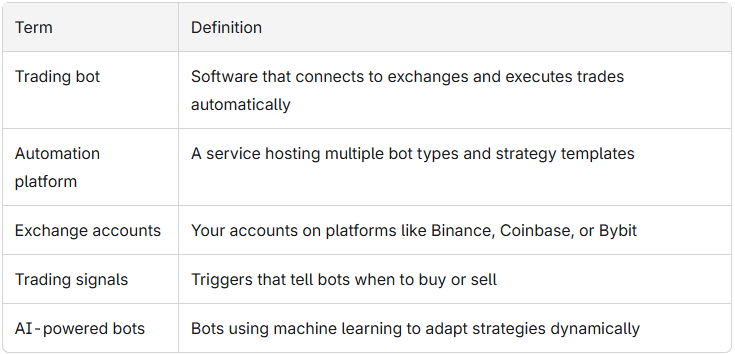
The connection between trading bots and exchanges is typically established via API keys, which allow access to market data and trade execution. When you connect a crypto trading bot to your Binance or OKX account, you grant it permission to read real time market data and execute trades on your behalf—without giving it withdrawal access.
The contrast between bots and human traders is stark. Automated trading systems can operate 24/7, responding to market shifts in milliseconds and are unaffected by human emotions like fear or greed. Meanwhile, humans bring contextual judgment and adaptability but inevitably get tired, make emotional decisions, and cannot monitor markets around the clock.
In 2026, automated crypto trading serves both hobby traders running simple dollar cost averaging strategies and professional desks deploying sophisticated algorithmic trading systems.
How Auto Crypto Trading Works in Practice
Consider this concrete example: a user connects their Binance account, selects a grid bot targeting BTC/USDT between $55,000 and $65,000, configures a 2% maximum position size, and lets it run for several weeks. The bot automatically places buy orders near the lower range and sell orders near the upper range, capturing profits from price movement oscillations.
The automated trading process typically includes data analysis, signal generation, risk allocation, and execution. Here’s how the main components work together:
- Data feed: Receives real-time price information, order book depth, and trading volume from the exchange
- Strategy logic: Contains the trading algorithms—whether simple indicators or complex AI models—that generate signals
- Execution engine: Translates signals into actual exchange API calls to place, modify, or close orders
- Performance tracker: Monitors PNL, drawdown, win rate, and other metrics
Crypto trading bots often use technical indicators such as moving averages, Bollinger bands, and MACD to identify trading opportunities and make decisions based on market trends. Bots can analyze large amounts of data and execute trades in milliseconds, providing an advantage in volatile markets.
The typical workflow follows these steps:
- Connect exchange accounts via API keys
- Choose or build a trading strategy
- Configure risk management parameters
- Test via paper trading or backtesting
- Deploy with small capital and monitor
Regarding order types, bots can place market orders, limit orders, stop orders, OCO (one-cancels-other), and trailing stops. Advanced bots combine multiple orders—for example, entering a position with a limit order while simultaneously setting stop-loss and take profit levels.
Cloud-based bots run on vendor servers, meaning orders execute even when your computer is off. Self-hosted bots run on your VPS or local machine, offering more control but requiring you to manage infrastructure and connectivity.
Main Types of Crypto Trading Bots
This section classifies the most common auto trading approaches with concrete examples rather than abstract theory. Crypto trading bots are designed to automate the process of buying and selling digital assets based on predefined trading strategies, offering a variety of customizable options.
DCA Bots
DCA bots execute dollar cost averaging by purchasing a fixed dollar amount of BTC or ETH on a schedule—for example, buying $100 worth of Bitcoin every Monday at 09:00 UTC. This approach smooths volatility over time and builds long-term positions without requiring you to time the market. Many crypto traders prefer this method for its simplicity and psychological ease.
Grid Bots
Grid bots place multiple buy and sell orders within a predetermined price range. For BTC/USDT in 2026, you might set a grid between $55,000 and $65,000, with buy orders staggered at lower prices and sell orders at higher prices. The bot profits from sideways markets where price oscillates within the range. Grid bots work poorly during strong directional breakouts.
Trend-Following Bots
These bots use indicators like EMA crossovers, RSI, or MACD to ride medium-term trends on pairs such as ETH/USDT or SOL/USDT. A simple trend-following bot might buy when the 50-day EMA crosses above the 200-day EMA and exit when it crosses below. Performance depends heavily on market conditions and parameter tuning.
Arbitrage and Market-Making Bots
Arbitrage bots exploit price differences between exchanges—buying Bitcoin at $65,000 on Kraken and selling at $65,200 on Binance. Market making bots provide liquidity by placing simultaneous bid and ask orders. Common automated trading strategies include arbitrage, grid trading, dollar-cost averaging (DCA), and trend following. These approaches are usually for advanced traders or firms due to capital requirements and technical complexity.
AI-Powered Bots
Machine learning and LLM-based systems represent the frontier of automation. These bots adjust rules based on recent performance, market sentiment, or on-chain data. However, they are not magic profit machines—they still fail during unprecedented market conditions. Automated trading offers speed, consistency, and reduced emotional stress for traders, but AI systems require the same risk management discipline as any other approach.
Choosing the Right Trading Platform for Your Skill Level
The best trading platform depends on your experience, available time, and risk tolerance—not simply on which service has the longest feature list.
For Beginners
New users should prioritize:
- Clear interface with strong educational content and tutorials
- Paper trading mode for risk-free experimentation
- Pre-built strategy templates requiring no coding required
- Simple risk controls like max position size and basic stop loss
Pionex is known for offering 16 built-in trading bots that are free to use, making it a popular choice for automated trading among beginners.
For Intermediate Traders
As you gain experience, you’ll want:
- Access to multiple exchanges from one dashboard
- Advanced order types and a backtesting feature
- Strategy templates you can customize
- Detailed performance analytics
3Commas is a widely used crypto trading bot platform that supports advanced automation and strategy customization, appealing to both novice and experienced traders. Some of the best crypto trading bots for 2026 include Cryptohopper, Pionex, 3Commas, and Coinrule, each catering to different trading strategies and user experiences.
For Advanced Traders
Professional crypto traders prioritize API access for custom scripting, low latency execution, integration with external tools like TradingView alerts, and detailed logs. They often build their own crypto trading bot or heavily modify existing solutions.
Security Evaluation
Reputable crypto trading bots incorporate security features such as two-factor authentication and encryption to protect users’ accounts and trading data. Many trading bots ensure that users’ funds are solely accessible by them, meaning the bot provider does not have access to the exchange account or the ability to withdraw funds. Security measures for trading bots are designed to meet evolving threats, ensuring that user data and funds are protected against unauthorized access.
Always verify non-custodial design, granular API permissions, IP whitelisting, and transparency about key storage.
Risk Management for Automated Crypto Strategies
Even the best trading bots can lose money without strict risk management, especially in volatile markets. The crashes of March 2020 and November 2022 demonstrated that leverage, inadequate stop-losses, and over-concentration can devastate accounts regardless of technical sophistication.
Automated trading is not a guaranteed form of income and requires careful strategy formulation.
Core Concepts to Configure
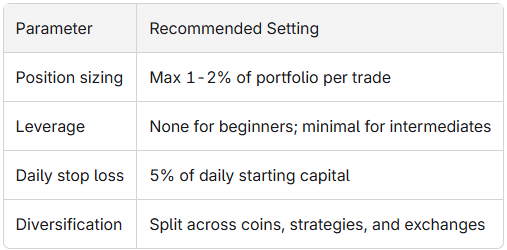
Emotion-free trading helps prevent common mistakes like panic selling. Automated systems can facilitate consistent execution of trading strategies, helping to avoid human error—but they cannot eliminate market risk.
Stop-Loss and Take-Profit Configuration
Every position needs predefined exit points. Options include:
- Fixed stop-loss (exit if price drops X%)
- Trailing features that move stops upward as price rises
- Partial take profit to lock in gains while letting winners run
- Smart trade configurations combining multiple exit conditions
Infrastructure Risks
Common risks associated with automated trading include market crashes, technical failures, and reliance on external factors like API stability. Mistakes in strategy configuration can lead to significant trading losses when using automated systems. Use conservative settings and avoid over-optimization on historical data.
Paper Trading, Backtesting, and Social Trading
Modern platforms in 2026 support three tools to reduce risk before deploying real capital: paper trading, backtesting, and social trading.
Paper Trading
Paper trading simulates trading on real-time market data with no real funds at risk. Run a bot at least 2-4 weeks in paper mode to observe behavior, verify order execution, and identify bugs. Many platforms offer this feature for new users to practice without financial exposure.
Backtesting
Many crypto trading bots come equipped with a backtesting feature that allows users to test their trading strategies on historical data before executing them in real-time. Running a strategy against BTC data from 2020-2025 estimates past performance.
However, backtesting capabilities allow traders to test strategies against historical data before risking capital—but strategies that are over-optimized for historical data may perform poorly in live markets. Effective backtesting should create realistic simulations that account for factors like slippage and latency to provide accurate performance insights.
Social Trading
Social trading enables following or copying top crypto traders through public leaderboards or a bot marketplace. This helps less experienced traders learn from other traders with proven track records. However, always check drawdowns, risk levels, and strategy transparency before allocating capital.
Start with backtesting to identify promising strategies, then paper trading to validate execution, then gradually deploy small live capital.
Connecting and Managing All Your Exchanges
Many crypto traders maintain multiple exchange accounts for better fees, improved liquidity, and jurisdictional flexibility. Managing them from one interface simplifies portfolio management significantly.
API Connection Setup
Connect exchange accounts using API keys with these permissions:
- Enable: Read access and trade execution
- Disable: Withdrawal access (critical for safety)
This ensures that even if API keys are compromised, attackers cannot drain your funds from the crypto exchange.
Benefits of Unified Management
Managing all your exchanges from a single trading platform provides:
- Unified portfolio view across Binance, Kraken, Coinbase, and others
- Cross-exchange bots for arbitrage opportunities
- Simplified risk monitoring and reporting
- Centralized trading signals and share signals functionality
Specific use cases include running arbitrage between Binance and Kraken, or holding long-term positions on Coinbase while deploying a futures bot on Bybit. Automated trading can enhance trading efficiency by allowing users to manage multiple trades across different exchanges simultaneously, which is particularly beneficial in the fast-paced cryptocurrency market.
Review each exchange’s API limits, allowed order types, and low trading fees before connecting any automation solution.
AI-Powered Auto Crypto Trading in 2026
AI-powered bots have evolved significantly by 2026, moving from simple indicator combinations to models incorporating order book depth, volatility metrics, funding rates, and news feeds for market sentiment analysis.
How AI Workflows Operate
Typical AI agent workflows include:
- Model training on historical tick data
- Paper trading validation in live market conditions
- Continuous performance monitoring
- Automated parameter adjustments when market regime shifts
Realistic Expectations
Users should always monitor and review automated trading systems to adapt to new market conditions. AI can adapt faster than static rules but still fails during black-swan events or regime shifts it has never encountered.
Concrete AI use cases include dynamic position sizing based on volatility, adaptive stop-loss placement, and identifying unusual trading volume spikes across BTC, ETH, and top altcoins. Platforms like Token Metrics leverage over 80 on-chain and off-chain data points to generate trading signals.
Transparency Matters
Avoid pure “black box” models. Prefer platforms providing at least basic transparency, decision logs, and override controls for human traders to maintain full control. The best AI bot solutions allow you to optimize strategies while retaining the ability to intervene manually when needed.
Step-by-Step: How to Automate Your Trading Safely
Here’s a concrete, chronological checklist for getting started with auto crypto trading.
Step 1: Define Goals and Constraints
Determine your target timeframe, which coins you’ll trade, maximum drawdown tolerance, and weekly time commitment. Writing these down prevents scope creep and emotional decisions later.
Step 2: Select a Crypto Exchange
Choose one or several exchanges fitting your country, KYC requirements, and fee structure. Enable API access with trading-only permissions. Popular options include Binance, Coinbase, Bybit, and OKX—each with different strengths.
Step 3: Choose Your Bot Type
Select a trading platform or bot type (DCA bots, grid bots, trend-following, AI-powered) appropriate for your skill level. Automate your trading only with tools you understand. Reputable automated trading platforms often come with fees and require ongoing maintenance.
Step 4: Configure a Starter Strategy
Begin with something simple—BTC DCA or ETH trend-following with conservative risk management. Automated trading allows investors to execute trades based on predefined strategies without the need for constant monitoring. Run it in paper trading mode first.
Step 5: Go Live and Monitor
Deploy small capital, monitor daily or weekly, and refine parameters iteratively. Using automated trading bots can reduce emotional decision-making, as trades are executed based on algorithms rather than human emotions, leading to potentially more rational investment decisions. Keep a trading journal documenting what works and what doesn’t.
Automated trading systems often require regular monitoring to ensure strategies remain relevant as market conditions shift.
FAQ
Is auto crypto trading suitable for complete beginners?
Beginners can absolutely start with simple bots like BTC or ETH DCA on user-friendly trading platforms, as long as they risk only small amounts and use paper trading first. Social trading and strategy marketplaces help new users copy experienced traders with proven results. However, beginners should still understand basic concepts like stop loss, drawdown, and position sizing before deploying real capital. The trading community offers extensive educational content for those willing to learn.
How much money do I need to start using crypto bots?
In 2026, many exchanges allow starting with as little as $50-$200, though practical auto trading with multiple positions is usually more comfortable from $500-$1,000 upward. Never allocate money you cannot afford to lose. Scale gradually as you verify results through paper trading and small live positions. The support team at most platforms can help you understand minimum requirements.
Can auto trading bots guarantee profits?
No bot or AI-powered system can guarantee profits in crypto markets, regardless of marketing claims or past performance screenshots. Bots simply execute a strategy consistently—if the strategy is poor or market conditions change dramatically, losses remain possible. Ongoing monitoring and risk management are essential. The crypto market is inherently volatile, and even sophisticated trading software cannot eliminate this risk.
Do I have to keep my computer on 24/7 for auto trading?
Cloud-based bots run on remote servers, so you don’t need to keep devices running. Your trades execute whether your computer is on or off. Self-hosted bots require a computer or VPS to stay online continuously. Beginners typically prefer cloud-based solutions to avoid managing hardware, while advanced traders sometimes choose self-hosting for extra control and potential bug fixes on their own timeline.
How are taxes handled when using crypto trading bots?
Every taxable event created by a bot—such as selling BTC for profit—is treated the same as manual trades by tax authorities in most countries. Bots automate execution, not tax compliance. Export trade histories regularly from your crypto exchange and trading platform, and consider specialized crypto taxes software if running high-frequency strategies. Consult a tax professional familiar with your jurisdiction for specific guidance on decentralized exchanges and complex strategies.