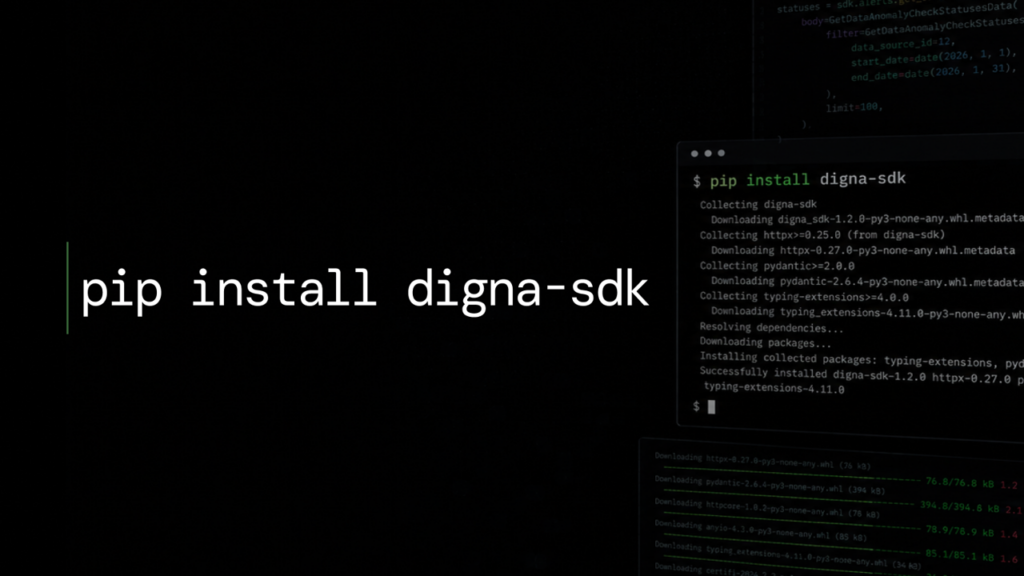
Data observability has become a critical part of building reliable data products. Engineering teams no longer treat data quality as a separate activity performed after deployment. Instead, they integrate monitoring, validation, and anomaly detection directly into daily workflows. This shift explains the growing interest in tools that can be accessed through code rather than only through graphical interfaces. A notable example is the introduction of the digna Python SDK, announced as part of Release 2026.06. According to the official release notes, the new SDK gives developers and data scientists direct programmatic access to key observability functions within the digna platform. This approach reflects a broader trend across the data industry, where automation and infrastructure-as-code principles continue to shape how teams manage complex environments.
Bringing Data Quality Into Existing Workflows
Many organizations already rely on Python for data engineering, analytics, machine learning, and orchestration. As a result, switching between dashboards and development environments often slows down routine tasks. The release of the digna Python SDK addresses this challenge by allowing users to interact with the platform from within their existing Python-based workflows. Instead of manually configuring resources through a web interface, teams can create projects, manage datasets, configure tables, launch inspections, and retrieve results directly through code. This capability reduces repetitive work and helps standardize observability processes across multiple environments. For companies operating large-scale data pipelines, automation is often the difference between reactive and proactive data management. When observability tools become programmable, monitoring can run alongside ingestion jobs, transformation processes, and deployment pipelines without requiring constant manual intervention.
A Practical Tool for Data Scientists
The value of observability extends far beyond engineering teams. Data scientists frequently struggle with issues that originate in the underlying data. Unexpected distribution shifts, unstable datasets, missing values, or changing patterns can affect model performance long before these problems become visible in production. Through the digna Python SDK, observability outputs can be accessed directly inside notebooks and machine learning workflows. This allows data scientists to analyze validation results and anomaly detection signals during model development rather than discovering issues after deployment. Imagine training a recommendation model on customer behavior data. If user activity patterns suddenly change, observability metrics can reveal the shift early. The team can then adjust training datasets or investigate the root cause before model accuracy declines. This creates a more reliable foundation for machine learning projects.