Recognition has always mattered at work, but the way it gets delivered has changed completely. Walking over to someone’s desk to say “great job” or calling out a win in a team huddle simply doesn’t translate when half your team is working from kitchen tables and coworking spaces across different time zones. For remote and hybrid teams, recognition now has to be intentional, visible, and built into the tools people already use every day.
The good news is that the platforms designed to handle this have matured significantly. What used to be clunky add-ons or generic shoutout boards have evolved into thoughtful systems that integrate with Slack, Microsoft Teams, and HRIS platforms, making appreciation a natural part of the workflow rather than an afterthought. Companies that have figured this out are seeing measurable improvements in retention, engagement, and team cohesion.
This article walks through what makes a recognition platform actually work for distributed teams, the features that matter most, and how to choose the right fit for your company’s culture and size.
Why Recognition Hits Differently in a Distributed Workforce
When teams sat together in offices, recognition happened organically. Casual praise, lunchtime conversations, and visible body language all reinforced a sense of appreciation that nobody really had to plan for. Remove the office, and that informal feedback loop disappears almost entirely. People do good work, and nobody notices. Or worse, nobody says anything.
For remote and hybrid teams, this creates a slow erosion of morale that’s hard to spot until people start leaving. Employees who don’t feel seen disengage. Disengaged employees produce less, communicate less, and eventually move on to companies where they feel valued. The cost of replacing them, both financial and cultural, is significant.
“Remote employees can do great work for months without anyone really noticing. That invisibility is what burns people out,” says Tal Holtzer, CEO of VPSServer.
Recognition platforms exist precisely to fill this gap. They give managers and peers a structured way to surface good work, celebrate milestones, and reinforce the behaviors that drive results. Done well, they create a culture where appreciation is constant, public, and tied to the actual work being done.
According to a Gallup study on workplace recognition, employees who don’t feel adequately recognized are twice as likely to say they’ll quit within the next year. For distributed teams, where the signals of dissatisfaction are harder to read, that’s a risk worth taking seriously.
Recognition isn’t just about making people feel good, either. It directly shapes performance. Teams that consistently recognize good work tend to repeat it. Behaviors that get acknowledged become norms. That feedback loop is one of the most underrated drivers of high-performing remote cultures.
What to Look for in a Recognition Platform
Not every recognition tool is built for distributed teams. Some were originally designed for offices and bolted on remote functionality later. Others were built remote-first and feel native to the way modern teams work. The difference shows up quickly once you start using them.
The platforms that work best for remote and hybrid teams share a few common traits.
Deep Integration With Daily Tools
If a recognition platform requires employees to log into a separate website to use it, adoption will suffer. The best tools live inside Slack, Microsoft Teams, or whatever platform your team already uses to communicate. Recognition becomes a one-click action embedded in the flow of work, not a separate task to remember.
This matters more than it might seem. The friction between “I want to recognize someone” and “I actually do it” is often what determines whether a recognition program succeeds or fades within a few months.
Peer-to-Peer Functionality
Manager-driven recognition has its place, but it’s peer recognition that builds real culture. When teammates can call out each other’s contributions directly, recognition stops feeling top-down and starts feeling like a genuine part of how the team operates.
Look for platforms that make peer recognition easy, public, and frequent. Private kudos are nice, but visible recognition is what shapes culture.
Meaningful Rewards Tied to Recognition
Recognition without any tangible follow-through can start to feel hollow over time. The strongest platforms pair shoutouts with reward systems, whether that’s points that can be redeemed for gift cards, charitable donations, branded swag, or experiences. The reward doesn’t have to be lavish. It just needs to feel real.
“Trust is built when promises are kept. The same goes for recognition. If a reward is mentioned, it has to actually arrive, and the experience around it has to feel smooth,” says Karina Simonovič, Marketing Manager at Optimal Warranty.
The key is choice. Employees in different countries, life stages, and circumstances value different things. A platform with a flexible global rewards catalog will outperform one that defaults to a single gift card option.
Analytics That Actually Help Managers
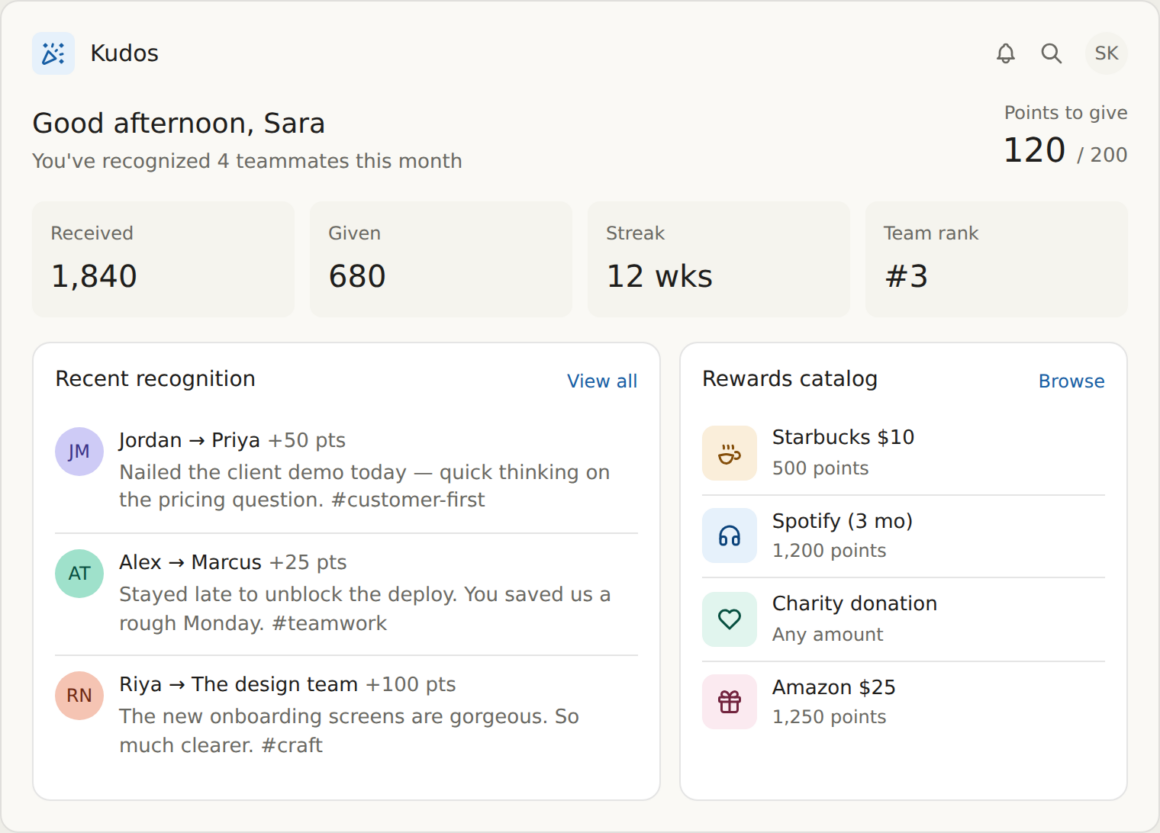
Good recognition platforms don’t just enable kudos. They give leaders visibility into who’s being recognized, who isn’t, and where engagement might be slipping. That data is genuinely useful for spotting team dynamics issues before they escalate, and for making sure recognition isn’t accidentally concentrated among a few visible employees.
Top Recognition Platforms for Remote and Hybrid Teams
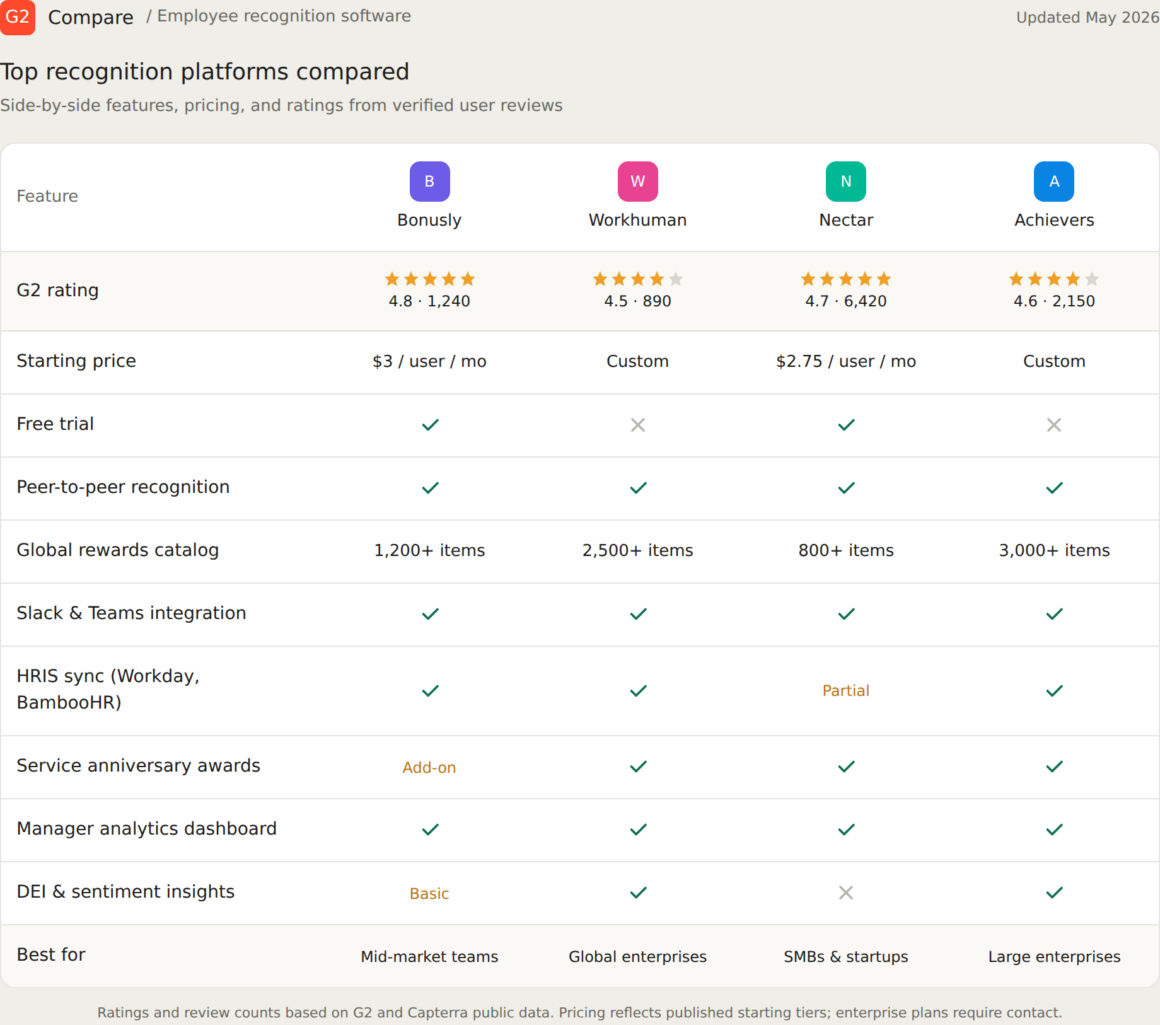
The market has plenty of options, but a handful of platforms consistently stand out for distributed teams. Each has its own strengths, and the right fit depends on your team size, budget, and culture.
Bonusly
Bonusly is one of the most widely adopted peer-to-peer recognition platforms, and for good reason. It integrates cleanly with Slack and Teams, gives every employee a monthly allowance of points to give to coworkers, and offers a global rewards catalog that works across borders. The interface is simple enough that adoption tends to be high without much push from leadership.
It works particularly well for small to mid-sized teams that want recognition to feel democratic and ongoing. Larger enterprises sometimes outgrow it, but for companies under a few thousand employees, it’s hard to beat for ease of use.
Workhuman
Workhuman is the more enterprise-focused option, designed for organizations that want recognition tied to performance management, values reinforcement, and broader cultural initiatives. It includes tools for service awards, milestone celebrations, and conversations between managers and direct reports.
The depth comes with more complexity, but for larger organizations with formal HR processes, Workhuman offers the kind of integration and reporting that simpler tools can’t match.
“The right recognition tool depends entirely on your team’s size and rhythm. Match the tool to the team, and adoption takes care of itself,” says Beni Avni, founder of New York Gates.
Kudos
Kudos focuses on tying recognition to company values. Every kudos sent gets categorized against a value, which over time builds a clear picture of which behaviors are being reinforced across the organization. For companies that have invested in defining their values and want to see them lived out daily, that connection is genuinely useful.
It also offers strong analytics and a clean mobile experience, which matters for teams spread across regions and time zones.
Nectar
Nectar is a more affordable option that punches above its weight, particularly for smaller teams and startups. It offers peer recognition, customizable rewards, automated celebrations for birthdays and work anniversaries, and integrations with the major communication platforms. The pricing is straightforward, and the setup is fast.
For teams just starting to formalize recognition, Nectar is often a sensible first step.
Motivosity
Motivosity blends recognition with feedback and engagement features, including pulse surveys and manager check-in tools. The platform leans toward a holistic view of employee experience, treating recognition as one piece of a larger picture rather than a standalone activity.
It’s a good fit for companies that want to consolidate engagement tools into a single platform rather than stitching together multiple solutions.
The Role of Culture in Making Recognition Work
A platform alone won’t fix a recognition problem. The companies that get this right pair the right tool with the right cultural habits. That means leadership modeling the behavior, regular nudges to keep recognition flowing, and a clear sense of what kinds of contributions deserve to be celebrated.
“The platform is the channel, but leadership is the signal. If senior leaders never use it, the team picks up on that quickly,” says David Lee, Managing Director at Functional Skills.
A common mistake is rolling out a platform with great fanfare and then letting it fade after the first few weeks. Sustained recognition takes intention. Some companies build it into weekly team meetings, asking each person to share a kudos before the agenda begins. Others tie it to performance reviews or quarterly all-hands. The mechanism matters less than the consistency.
It’s also worth being thoughtful about who’s getting recognized and for what. If recognition consistently flows to the loudest voices or most visible roles, it can quietly reinforce bias and leave quieter contributors feeling overlooked. Good platforms surface this data so leaders can correct course before it becomes a bigger problem.
How Hybrid Teams Add Another Layer of Complexity
Fully remote teams have a clear challenge: everyone is distributed, so recognition systems need to work for that reality. Hybrid teams have a subtler challenge.
When some people are in the office, and others aren’t, recognition can unintentionally concentrate around the in-office employees who are simply more visible.
Managers see them in person. They overhear conversations about what those employees are working on. Casual praise happens naturally. Meanwhile, the remote contributors doing equally good work can fade into the background unless someone makes a deliberate effort to surface their contributions.
Recognition platforms help close this gap by making appreciation public and trackable. When kudos are visible across the whole team, it doesn’t matter whether the recipient was in the office that day. The recognition lives in a shared space that everyone can see. That visibility alone goes a long way toward equalizing the experience.
Some platforms are also starting to incorporate AI features that prompt managers when an employee hasn’t been recognized in a while, or when recognition seems unevenly distributed across a team. These nudges might feel small, but they help managers correct blind spots they didn’t even realize they had.
Measuring the Impact of Recognition Programs
Once a recognition platform is in place, the next question is whether it’s actually working. The metrics worth tracking go beyond participation rates, though those matter too.
The clearest signals are in retention and engagement data. Are recognition recipients staying longer? Are engagement scores trending up among teams with high recognition activity? These are the questions leadership cares about when justifying the spend.
“Recognition is one of the cheapest and most overlooked investments a company can make. The cost of replacing a good employee almost always dwarfs the cost of making that employee feel valued,” says Jeffrey Zhou, CEO and Founder of Fig Loans.
A few specific metrics that recognition platforms typically surface:
- Recognition frequency, meaning how often employees give and receive recognition over a defined period
- Distribution patterns, showing whether recognition is concentrated among certain teams, roles, or seniority levels
- Value alignment, tracking which company values are being reinforced through recognition and which are being underemphasized
- Engagement correlation, comparing recognition activity against engagement survey data to see whether the two move together
For more on how recognition translates into measurable business outcomes, the SHRM Foundation’s research on employee recognition offers a useful framework. It connects recognition practices to retention, productivity, and culture metrics in a way that’s particularly relevant for HR leaders making the case to executives.
Looking Ahead: Where Recognition Is Going
Recognition platforms aren’t standing still. A few trends worth paying attention to over the next couple of years: AI-driven prompts will become more sophisticated, helping managers spot recognition gaps and suggesting moments where appreciation might be especially meaningful. Personalization will deepen, with platforms learning what kinds of rewards and recognition styles each employee actually responds to, rather than treating everyone the same.
Integration with broader employee experience tools will also continue. Recognition will increasingly live alongside feedback, goal tracking, and learning platforms in unified dashboards, giving managers a more complete picture of how their teams are doing.
“What works for a team in one country won’t always work for a team in another. Good recognition reads the room. It respects how people prefer to be acknowledged, not just that they get acknowledged,” says Gavin Yi, Founder and CEO of Yijin Solution.
And as remote and hybrid work continues to be the norm rather than the exception, recognition platforms will become less of a “nice to have” and more of a baseline expectation. Companies that don’t have a thoughtful recognition strategy will increasingly stand out, and not in a good way.
Conclusion
The best employee recognition platforms for remote and hybrid teams aren’t necessarily the ones with the most features. They’re the ones that fit naturally into how your team works, scale with your culture, and make appreciation feel genuine rather than performative.
Whether that’s Bonusly for a fast-growing startup, Workhuman for an enterprise with formal HR processes, or Nectar for a small team just getting started, the right tool exists for almost any context. What matters more than the specific platform is the commitment behind it. Recognition has to be consistent, visible, and equitable to actually shape culture.
For distributed teams, especially, that intentionality is what separates the companies people stay at from the ones they quietly start looking to leave. The platforms exist. The strategies are well understood. The opportunity is in showing up and using them with the care that remote and hybrid work genuinely demands.