A Chinese-language messaging setup on Windows involves more than switching one menu from English to Chinese. The desktop package, download source, interface language, input method, notifications, file storage, sessions, and update path all affect the final user experience.
This matters in multilingual teams and cross-border environments where users may read one language, type in another, and still need a predictable Windows configuration that support staff can reproduce.
A consistent setup solves two separate questions:
1. Install and maintain the correct desktop software.
2. Make the application comfortable and understandable for Chinese-language use.
The workflow below keeps those questions separate: first install and verify the Windows client, then localize the interface and input environment, and finally standardize the settings that affect security and daily use.
Choose and Verify the Correct Windows Desktop Client
Before changing any Chinese-language setting, confirm that the PC is using the intended Windows desktop edition.
Messaging platforms may provide several access options:
- Standalone Windows installer
- Microsoft Store edition
- Browser-based interface
- Portable desktop build
- Different packages for different system environments
The options can look similar after launch, but their installation, update, permission, and storage behavior may be different.
For users researching telegram windows 中文, the key distinction is between obtaining the correct Windows desktop package and configuring Chinese as an interface or input preference after installation.
The recommended process is:
1. Select the correct Windows edition.
2. Verify the software source.
3. Install the desktop client.
4. Confirm that it works normally.
5. Configure the Chinese interface.
6. Review Windows-specific settings.
Keeping package selection separate from language configuration makes later troubleshooting much easier.
Confirm Windows Compatibility
Before installation, check that the application is appropriate for the PC.
Useful information includes:
- Windows 10 or Windows 11 support
- 64-bit architecture
- Available disk space
- Installation privileges
- Update requirements
- Network restrictions
- Security-software compatibility
For managed PCs, document the supported Windows version, architecture, permissions, and update method before wider deployment begins.
A standard device baseline reduces configuration drift when the same messaging client is used by multiple people or teams.
Verify the Software Source
A Chinese-language guide can explain how to use an application, but it does not by itself prove that an installer comes from a trustworthy distribution path.
Users should always check where the actual Windows package comes from.
Before downloading:
- Review the domain carefully
- Confirm that the page matches the intended software
- Watch for unexpected redirects
- Check the installer filename
- Review publisher information
- Avoid unrelated download managers
- Be cautious with bundled software
If the path from page to installer is difficult to understand, stop and verify the domain, redirects, filename, and publisher before continuing.
That check matters for communication software because the installed client may later hold private messages, persistent account sessions, and downloaded documents.
Install the Standard Client Before Localizing It
Installation and localization should be treated as separate stages.
Avoid treating a specially modified “Chinese version” executable as necessary when the normal desktop client can provide localization through settings.
A cleaner model separates software installation from language preference:
Stage 1: Install the standard desktop application
Focus on:
- Correct package
- Verified source
- Successful installation
- Windows compatibility
Stage 2: Configure Chinese-language preferences
Focus on:
- Interface language
- Character display
- Input methods
- Notifications
- Regional usability
This separation makes it easier to tell whether a problem comes from the package, Windows, or localization settings.
Configure Chinese Language and Input Settings
Once the desktop application is installed and operating normally, configure the interface language as a user-experience setting rather than a download decision.
The exact menu location may vary between versions, but the general process is usually similar:
1. Open the desktop application.
2. Go to Settings.
3. Locate the language or interface section.
4. Select the preferred Chinese-language option.
5. Restart the application if required.
6. Confirm that menus and settings display correctly.
For team deployments, decide whether the organization needs a default interface language while still allowing supported regional preferences.
- Traditional Chinese
- Simplified Chinese
- English
- Different defaults by region
The best default is the one that matches the actual users and support environment.
Choose Traditional Chinese, Simplified Chinese, or English Deliberately
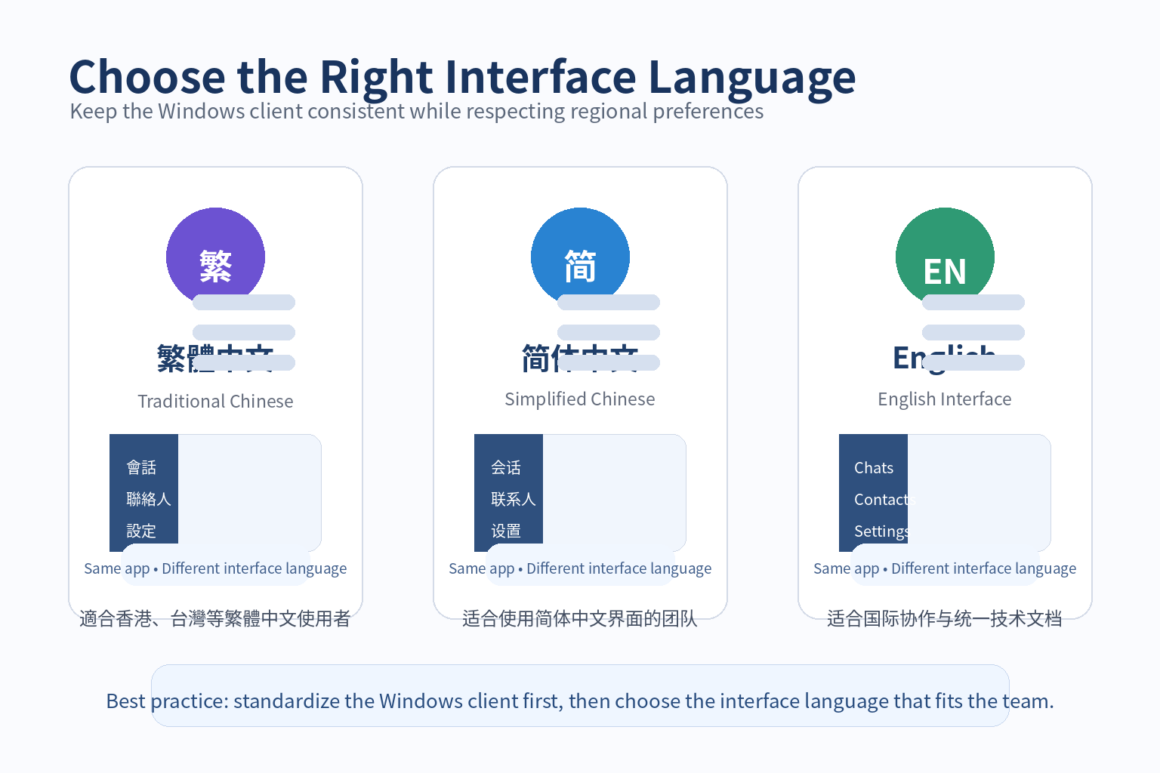
Different Chinese-speaking regions may prefer different interface conventions.
For example:
- Hong Kong users may prefer Traditional Chinese
- Taiwan users commonly use Traditional Chinese
- Other teams may prefer Simplified Chinese
- International teams may keep English as the default
Standardization should improve usability, not force every region into a language convention that does not match its users.
A practical policy can define a default while allowing approved alternatives for teams in Hong Kong, Taiwan, mainland China, or multilingual offices.
Verify Chinese Character Rendering
After changing the interface language, check whether Chinese characters display correctly throughout the application.
Test:
- Menus
- Notifications
- Search results
- File names
- Group names
- Usernames
- Settings pages
If some Chinese text renders incorrectly, check the Windows environment before assuming the messaging client itself is faulty.
Possible causes include:
- Missing fonts
- Remote desktop environments
- Unusual regional settings
- Legacy system configurations
A usable localized interface should remain readable across menus, notifications, search, names, and file paths.
Configure Windows Input Methods Separately
Changing the application interface does not automatically configure Chinese typing at the operating-system level.
Users who regularly type in Chinese should configure the appropriate input method.
A basic process can include:
1. Open Windows language settings.
2. Add the required Chinese language or keyboard.
3. Select the preferred input method.
4. Learn the shortcut for switching between languages.
5. Test Chinese input inside the messaging client.
For bilingual users, quick switching between English and Chinese input can have a direct effect on day-to-day productivity.
Treat interface language and installer provenance as separate questions. A localized experience does not remove the need to verify the Windows package.
When users search for 电报官方下载, the practical task is to confirm that the Windows package follows a clear download path and that the resulting installer matches the expected application and publisher.
Check:
- Whether the page explains the available Windows edition
- Whether the download points to the expected software
- Whether the file name is appropriate
- Whether the publisher information matches expectations
- Whether unrelated programs are offered
Labels such as “official,” “download,” or “Windows” are useful context, but they should not replace verification of the actual file and publisher.
Inspect the Installer Before Running It
Before running the downloaded package, inspect it.
Right-click the file and open Properties.
Review:
- File description
- Product name
- Version
- Company or publisher
- Digital signature
If the product name, publisher, version, or signature appears unrelated to the intended application, stop and verify the source again.
A brief verification step is usually easier than cleaning up an unwanted or incorrect installation later.
Scan the Installer With Windows Security
Use Windows Security or the organization’s normal endpoint-security platform as an additional check before execution.
Windows SmartScreen may also display warnings for unfamiliar applications.
Do not dismiss an unexpected warning automatically; use it as a reason to recheck the source, publisher, and file details.
Instead, check:
- Download source
- Publisher
- Digital signature
- Version
- File name
For organizations, security warnings should be reported rather than bypassed without review.
After installation and localization, notifications should be configured around the user’s work style.
A messaging client may generate alerts for:
- Direct messages
- Groups
- Channels
- File activity
- Mentions
- Calls
Too many notifications reduce productivity.
A useful configuration can prioritize:
Direct messages Keep alerts enabled when rapid responses matter.
Active workgroups Enable notifications for current projects.
General communities Mute or reduce notifications.
Announcement channels Use visual alerts without unnecessary sound.
The goal is to keep important conversations visible without turning every group or channel into an interruption.
Protect Message Privacy in Shared Workspaces
Notification previews may expose sensitive information on the desktop.
Windows can display:
- Sender names
- Message text
- Group names
- File names
Users in shared environments should consider reducing preview content.
This is useful in:
- Offices
- Coworking spaces
- Presentations
- Screen-sharing calls
- For shared offices, presentations, and screen-sharing sessions, reducing message previews can preserve awareness without exposing conversation content.
For especially sensitive presentations or screen-sharing sessions, temporary focus settings can provide an additional layer of privacy.
Use a Dedicated Messaging Download Folder
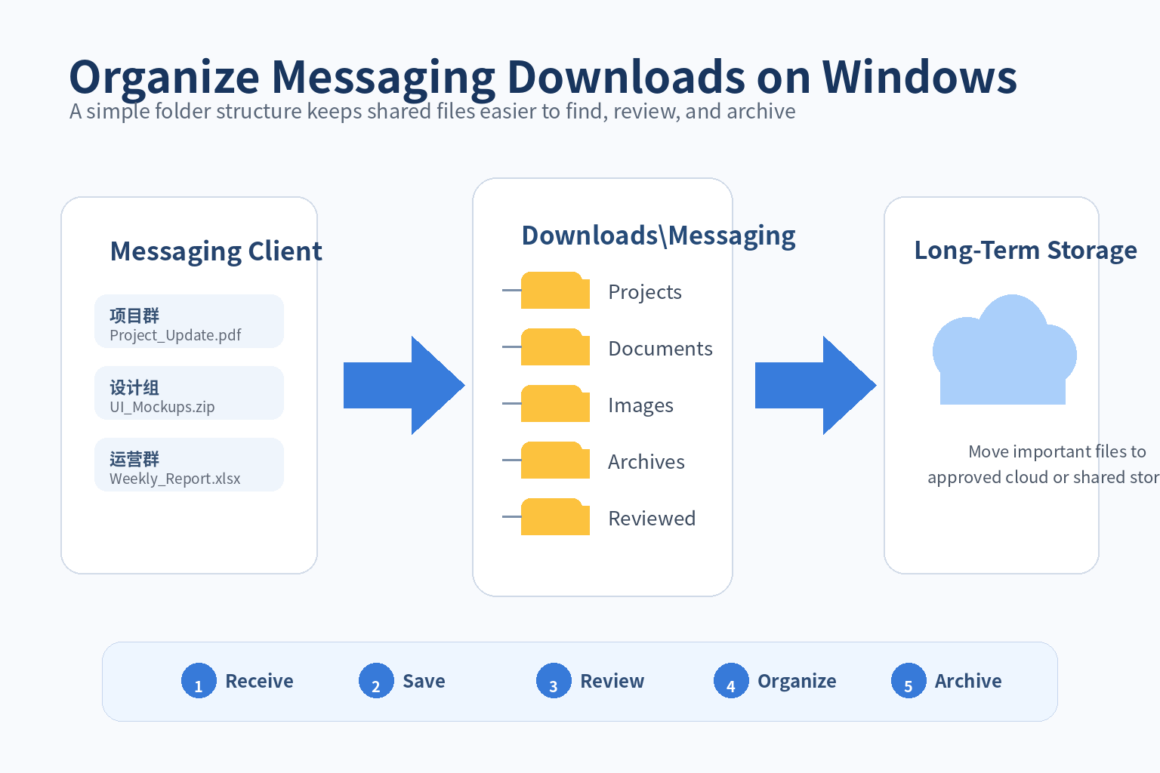
Messaging applications can become a major source of desktop files.
Users may receive:
- PDFs
- Documents
- Images
- Spreadsheets
- Presentations
- Archives
A dedicated folder makes these files easier to manage.
For example:
DownloadsMessaging
or:
DocumentsChat Downloads
This helps users:
- Find files quickly
- Scan suspicious downloads
- Move important documents to their proper long-term storage location instead of using the messaging download folder as a permanent archive.
- Periodic cleanup also prevents cached attachments from growing unnoticed on the local PC.
- Move important documents into permanent storage
The messaging folder should not become the organization’s long-term document archive.
Control Automatic File Downloads
Automatic downloads can be useful, but they should be configured intentionally.
Users may allow automatic downloading for:
- Small images
- Common documents
- Trusted workgroup content
while requiring manual approval for:
- Large files
- Archives
- Executable files
- A selective download policy reduces storage growth and limits the number of unnecessary files written to the local PC.
This approach reduces storage use and improves control over incoming content.
Separate Executables and Archives From Routine Documents
A secure messaging environment should distinguish ordinary work files from software packages.
Executable files such as:
- .exe
- .msi
- scripts
- compressed application packages
should receive additional verification.
Executable files, scripts, and unfamiliar archives deserve extra scrutiny even when they were received through a legitimate account or group.
Users should verify the sender, context, and source before executing software received through messaging.
Decide Whether the Client Should Start With Windows
Users who rely heavily on messaging may want the desktop client to launch automatically with Windows.
This can be useful for:
- Remote teams
- Support staff
- Operations teams
- Users who need continuous notifications
However, automatic startup is not necessary for everyone.
Use Windows Startup Apps settings to confirm the final behavior and to check for unexpected programs that were added during installation.
A standardized workplace deployment may also define a default startup policy.
Desktop applications may stay signed in for long periods.
Users should periodically review active sessions, especially after:
- PC replacement
- Windows reinstall
- Temporary workstation use
- Remote desktop access
- Device retirement
Close sessions that are no longer needed, especially after device replacement, Windows reinstallation, or temporary access from another PC.
Account-session management is an important part of maintaining a secure desktop environment.
Keep Updates on a Trusted Path
Desktop messaging clients receive updates for:
- Security fixes
- Performance improvements
- Windows compatibility
- New features
- Interface changes
Updates should come from trusted sources.
Recommended methods include:
- Built-in updater
- Use a predictable update channel so users and support teams can recognize where new versions are supposed to come from.
- Verified software source
- Organization-managed deployment
Users should avoid downloading random “latest versions” from unrelated websites.
Recheck Localization After Major Updates
Major application updates may change:
- Menu locations
- Language settings
- Notification controls
- File behavior
- Interface terminology
After a major update, Chinese-speaking users should verify:
- Interface language
- Character rendering
- Input behavior
- Download folder
- Notification preferences
- A quick post-update check prevents a small language or input change from becoming a recurring support problem.
Internal support documentation may also need to be updated.
Standardize the Setup for Teams
Organizations with many Chinese-speaking users can reduce support issues by defining a baseline configuration.
A standard profile might include:
- Approved Windows desktop edition
- Verified download source
- Traditional or Simplified Chinese default
- Notification rules
- Download folder
- Startup behavior
- Update policy
- A documented baseline gives support teams a common starting point while leaving room for approved regional or user-level preferences.
Users can still personalize secondary settings, but the core environment remains consistent.
Use Consistent Chinese and English Terminology
Multilingual environments can become confusing when technical terms are translated differently across documentation.
Teams should define consistent terminology for:
- Desktop client
- Download folder
- Installer
- Update
- Session
- Notification
- Privacy settings
Technical identifiers such as:
- File names
- Windows paths
- Version numbers
- Product names
Consistent terminology makes internal instructions easier to search and reduces confusion when users move between Chinese and English interfaces.
This makes support documentation more reliable.
Create a Short Internal Setup Guide
A useful internal guide can contain:
Download section
- Approved source
- Supported Windows edition
- Installer verification
Installation section
- Installation steps
- Publisher information
- Security scan
Language section
- Traditional/Simplified Chinese choice
- Interface settings
- Windows input method
Desktop section
- Notification defaults
- Download folder
- Startup behavior
Maintenance section
- Update policy
- Session review
- Reinstallation guidance
This gives users one consistent reference.
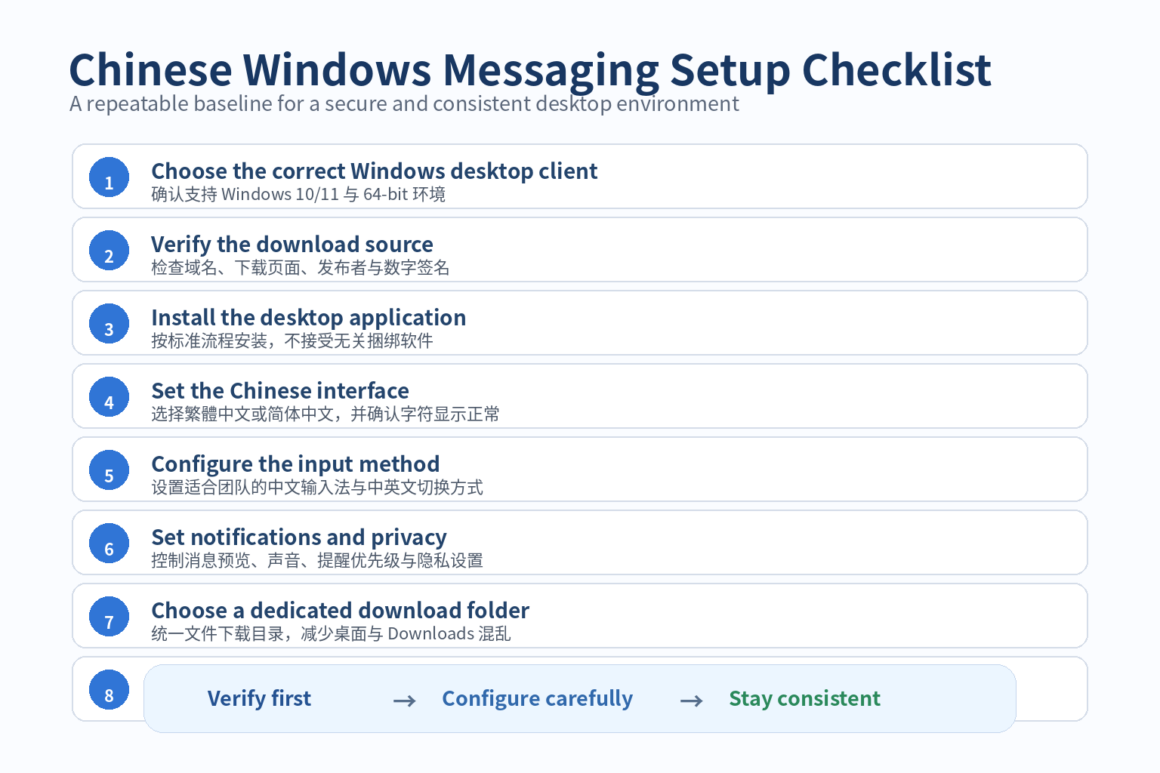
Chinese-Language Windows Messaging Checklist
Before installation
- Confirm the correct Windows desktop edition.
- Verify the download source.
- Review the installer.
- Check the publisher.
- Scan the file.
Installation
- Follow the normal installation process.
- Avoid bundled software.
- Confirm the installed version.
Chinese-language configuration
- Select the preferred interface language.
- Confirm Chinese character rendering.
- Configure the Windows input method.
- Test English/Chinese switching.
Desktop configuration
- Set notification preferences.
- Protect message previews.
- Choose a download folder.
- Control automatic downloads.
- Configure startup behavior.
Maintenance
- Keep the application updated.
- Use trusted update sources.
- Review active sessions.
- Recheck language settings after major updates.
- Update internal documentation when necessary.
Final Takeaway
A reliable Chinese-language messaging environment on Windows combines correct software selection with a verified download path, safe installation, usable localization, and predictable desktop settings.
A reliable setup combines:
- Correct Windows software selection
- Verified download sources
- Safe installation
- Interface localization
- Chinese input methods
- Controlled file downloads
- Appropriate notifications
- Reliable updates
- Secure session management
The strongest sequence is to install the intended Windows client first, verify that it works, and only then configure interface language and input preferences.
When package verification, Windows settings, and localization are treated as parts of one controlled workflow, Chinese-speaking users get a desktop environment that is easier to understand, reproduce, and support.