
Enterprise software teams and professional services firms have observed this evolution in AI image generation market from afar. The previous generation of image APIs had sufficient speed for consumer creative tools but were lacking in reliability and precision, consistency, and domain-specific accuracy that enterprise workflows require. The launch of Nano Banana 2 in February of ’26 marks a specific moment on the timeline of AI image generation: when cost and speed trade-offs that previously kept high-quality generation out of most production pipelines went from sad “pick one” to delightful “choose two.” This is the inflection point for enterprise product teams that really makes adding the Nano Banana 2 API to production-worthy software an architecture-worthy discussion.
Nano Banana 2 draws on the Gemini model’s real-world knowledge base and also now live information and images from web search in order to produce more accurate renderings of particular subjects, develop infographics and turn notes into diagrams. That capability profile — coupled with an instruction-following style that responds to requests more narrowly and faithfully, capturing specific meanings of a concept so an image produced is the one requested — expands the range of professionally useful application categories that previous Flash-tier models could not consistently fill.
This article maps six of those dimensions in detail, each of which is distinct from the consumer creative, media production and marketing scenarios discussed in earlier writing on this model. All of this, and more from APIPASS — the unified marketplace of APIs that includes Nano Banana 2 entering cheapest per image integration available from any provider.
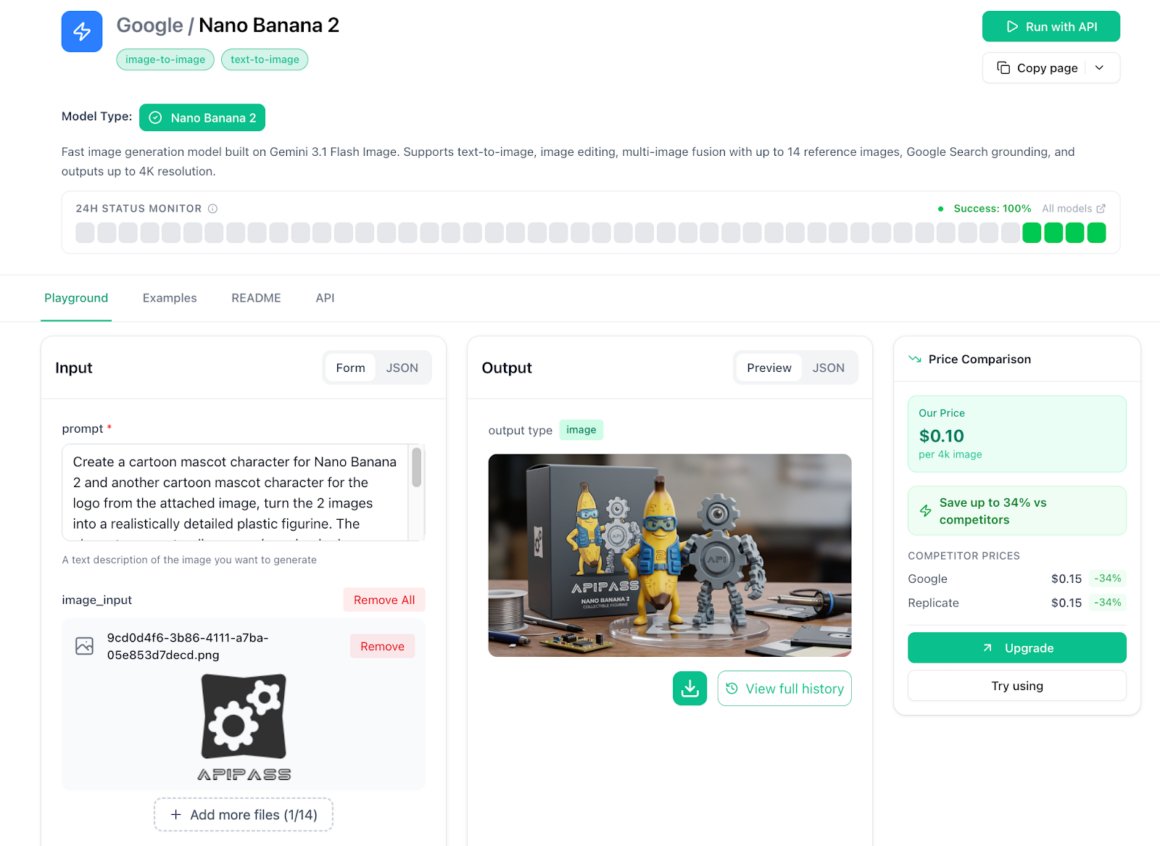
Nano Banana 2 API via APIPASS: The Cost Foundation for Enterprise Scale Workflows
Enterprise integrations produce images at such a volume that the per-image cost is a first-order business consideration. A SaaS solution with 50,000 active users who each generate several images in a given session can easily rack up millions of API calls per month. At those volumes, the delta in provider rates is no longer a rounding error — it’s a line item that touches product margin and pricing strategy.
APIPASS serves the Nano Banana 2 API for rates that are undercutting Googles official Gemini API consistently across every resolution tier:
| Model | Resolution | APIPASS API | Google Gemini API (Official) |
| Nano Banana 2 | 1024px (1K) | $0.046 / image | $0.067 / image |
| 2048px (2K) | $0.068 / image | $0.101 / image | |
| 4096px (4K) | $0.100 / image | $0.151 / image | |
| Nano Banana Pro | 1024px (1K) | $0.086 / image | $0.134 / image |
| 2048px (2K) | $0.091 / image | $0.134 / image | |
| 4096px (4K) | $0.173 / image | $0.240 / image |
That said, at 1K for $0.046 per image through APIPASS versus $0.067 through Google’s official API, that’s a saving of 31% on each generation. For an enterprise pipeline that produces one million images each month, APIPASS delivers $21,000 in monthly savings — and $252,000 (annualized) without any change to model output. Both Nano Banana 2 and Nano Banana Pro share the same APIPASS account and API key, so no extra credential management is required when dealing with direct Google Cloud integration. Having established those economics, here are the enterprise and professional service workflows where the Nano Banana 2 API adds significant new capability.
Nano Banana 2 API for Enterprise and Professional Workflows with APIPASS
SaaS Products Having Embedded Visual Generation Dynamics
It is ideal for high-quality image generation and conversational editing at a mainstream price point and low latency, finely-tuned for speed & extremely high-volume developer use cases. That combination also makes it the right model for SaaS teams that embed image generation directly into their product as a feature — not as a standalone creative tool, but rather to augment an existing workflow product.
For example, project management platforms can connect to Nano Banana 2 through APIPASS and dynamically generate visual summaries of project status, progress infographics, milestone illustrations, etc., all from structured project data. HR software platforms can automatically create tailored onboarding visual content — illustrated process diagrams, office maps, team org chart graphics — individualized for every new hire based on their role and department without any human involvement in the design process. Contract analytics legal tech platforms produce visual contract summaries and clause connectivity diagrams that facilitate the understanding of style or contractual language (Andresen, 2019). In both cases, the Nano Banana 2 API acts as an unnoticed embedded feature, not a visible AI image tool — and APIPASS’s per-image pricing scales the unit economics of providing this as a bundled offering from unviable to viable.
Integrated with the Gemini 3.1 Flash Image, HubX reported a reduction in latency by up-to 74–76%, thus rendering their face editing workflows four times faster at Pro-level quality. For teams in a SaaS context trying to judge integration timelines, that threshold from production deployment becomes a useful signal of what operational advantage the Nano Banana 2 API is adding at application scale.
Visual Communication in Healthcare & Medical Domain
Patient communication remains a dilemma for health care organizations: Clinical information is complex, high-stakes and routinely given in formats — dense text; technical diagrams oriented to clinical audiences — that patients are unable to readily meaningfully interpret. In summary, the technical aspects of the Nano Banana 2 API help it to be an appropriate basis for healthcare visual communication tools due specifically to its accurate text rendering capabilities from drawing diagrams based on world knowledge through infographics generation which can assist in creating data visualizations such as existing disease management systems.
A structured and interoperable patient education technology which employs the Nano Banana 2 API through a system like APIPASS could produce illustrated disease process descriptions, progression of condition diagrams, medication regimen infographics if such pathology/patient-education information is verifiably found within the model’s Gemini knowledge base including detailed medical domain knowledge. A specific high-value workflow that leverages the model’s ability to transform structured text inputs into coherent visual documents involves generating post-appointment summaries, where a patient’s clinical notes are translated into formal plain-language illustrative materials for consumption at home. Some telehealth platforms can automatically generate a visual summary of the treatment plan by integrating that into the consultation workflow. With APIPASS at $0.046 per image, the cost to generate a patient-facing visual summary per consult is negligible in relation to consultation value.
Architectural and Interior Design Client Proposal Generation
Before a project is confirmed, architectural firms and interior design studios invest substantial non-billable time creating visuals for client proposal mood boards, spatial concept illustrations, material palette presentations and preliminary layout visualizations. These visuals are critical to client decision-making, but are costly to create via traditional design workflows while a project is still pre-contract.
Nano Banana 2 provides full spectrum lighting, deeper textures, and cleaner details keeping the quality high end while his ability to render 3D (where it outperforms competing models in benchmark tests) gives it direct relevance into architectural visualization. The Nano Banana 2 API through APIPASS can create concept-stage spatial visualizations from room dimensions, material references and style briefs; generate several options of design direction based on a single client brief concurrently; and come up with photorealistic material palette boards that enable clients to visualize finishes and color combinations in context prior to specification. For the thousands of firms that manage high-volume proposal processes — residential developers, commercial fit-out specialists, hotel groups — automating preliminary visualization via the Nano Banana 2 API at $0.100 per quarter of 4K image through APIPASS turns fungible design time, once considered non-billable minutiae, into a repeatable low-cost pipeline step.
Visual Content for Corporate Learning and Development
57 As importantly, Nano Banana 2 possesses a knowledge of the world that is deep enough to run with their own type of functioning infusion — generating elements like infographics following current events, maps using recent information and brand assets linked to somewhat relevant real-world topics. For corporate L&D teams, this capability solves one of the most time-consuming content production bottlenecks within enterprise training: generation of scenario graphics, process models and case study visuals that tailor to the organization’s specific context, industry and brand.
Learning management system (LMS) makers can use the Nano Banana 2 API through APIPASS for customers to auto-create bespoke illustrations for course modules — workplace scenario images with characters that represent their workforce demographics, process flow diagrams that employ their actual terms and workflows, compliance training visuals that portray a customer-specific operational environment instead of generic stock images. For annual compliance refreshes, which often involve manual changes to content (such as replacing visual assets), the entire process can be semi-automated by generating examples that are relevant to updated policy text. Subject consistency across up to five characters, and fidelity across up to ten objects in a single workflow means recurring characters used throughout a training curriculum can maintain consistent appearance from module to module without onerous or time-consuming manual quality control.
A visual Automation System for Publishing and Self-Publishing
The self-publishing market has exploded, but the bottleneck for independent authors and content creators hasn’t changed: professional-grade visual assets — book covers, chapter header illustrations, interior diagrams, author promotional materials — take either a large budget or take a lot of time to create. Publish product operators and self-Publication tools that integrate the Nano Banana 2 API via APIPASS on their product, will be able to provide authors with automated visual content generation as a native feature part of the platform instead of an external cost-paid add-on.
Generating ideas for book covers from the genre of a manuscript, its title and examples of covers provided by the author seems like an obvious first use case to integrate. Delivering an upgrade in reliable text rendering — render can finally output with the same precision as the art, which is exactly what has kept AI image generation out of cover design until this technical requirement was met. Interior chapter illustrations from chapter summaries, stylization of the author headshot for PR materials, and management for series visual consistency — ensuring consistent aesthetic identity across multiple titles in a series — are all workflows handled at production scale via APIPASS by the Nano Banana 2 API. For 100,000 independently published writers using such a platform — providing three putative cover concepts per manuscript upload at $0.046/image costs $13,800/month pass-through via APIPASS and is rapidly absorbable into platform economics at that user scale.
Production of Visuals for Real Estate & Property Marketing
Unlike other industries, real estate marketing teams are governed by their own production pressure: every new listing requires a new package of visual assets — hero images, floor plan visualizations, neighborhood context images and representations of staged interiors — in a timeline set at the date of listing rather than at the availability for design. The Nano Banana 2 API via APIPASS satisfies a number of these requirements at once in ways that traditional photography and design workflows cannot match for both speed and cost.
Virtual staging — generating furnished interior images from photos of empty rooms — is the most immediately usable workflow. The image editing capability of the Nano Banana 2 API and its photorealistic 3D rendering makes it not only able to place furniture, lighting, and decor in unfurnished room photographs with spatial coherence relative to the ground plane but also have lighting coherence. Paged neighbor context image generation — search-grounded visualizations of a property’s surrounding environment, nearby landmarks and commute corridors — is immediately aided by the model’s Image Search grounding to generate accurate representations of specific locations; rather than generic approximations. Floor plan to isometric 3D visualization, transforming architectural drawings into accessible three-dimensional previews for listing pages, has yet another one based on model’s 3D rendering power.
As VentureBeat’s deep dive puts it: at a certain point, AI image generation becomes about the transition from novel creativity to production-quality infrastructure component and Nano Banana 2 is that point. For real estate tech platforms the use of image generation within listing management workflows is not a nice-to-have, so that description describes exactly why the Nano Banana 2 API via APIPASS should be considered as infrastructure instead of an additional feature. At the uninhibited $0.046 per image at 1K post through APIPASS, a five-image virtual staging set generated in these sessions will cost you a generation credit of — are you sitting down? — all of $0.23 — which definitely alters the V for R (return on investment) equation on any platform processing any meaningful volume of listings.
Why Use APIPASS for Enterprise Nano Banana 2 API Integration
Enterprise integrations need more than just pricing that beats the competition — they require operational simplicity, billing transparency, and a production-scale concurrent load platform. APIPASS delivers all three.
Nano Banana 2 and Nano Banana Pro are both available via a single unified API key, which means engineering teams can route different types of workflows to the right model tier in the same integration without having to manage separate Google Cloud projects, Vertex AI configurations or authentication credentials. The pricing is both transparent and per-image: there’s no token billing overhead hidden with cost allocation for internal reasoning processes. For example, infrastructure is built to have high-concurrency production workloads so that throughput does not waver as generation volume increases to meet user growth.
APIPASS offers the cost basis — 31% below Google’s official rate at each resolution tier — and operational simplicity to enable production systems with the Nano Banana 2 API from day one, for enterprise software teams and professional services firms ready to integrate.
*Get the Nano Banana 2 API via APIPASS today — enterprise-grade capability at the lowest available rate on the marketplace. *