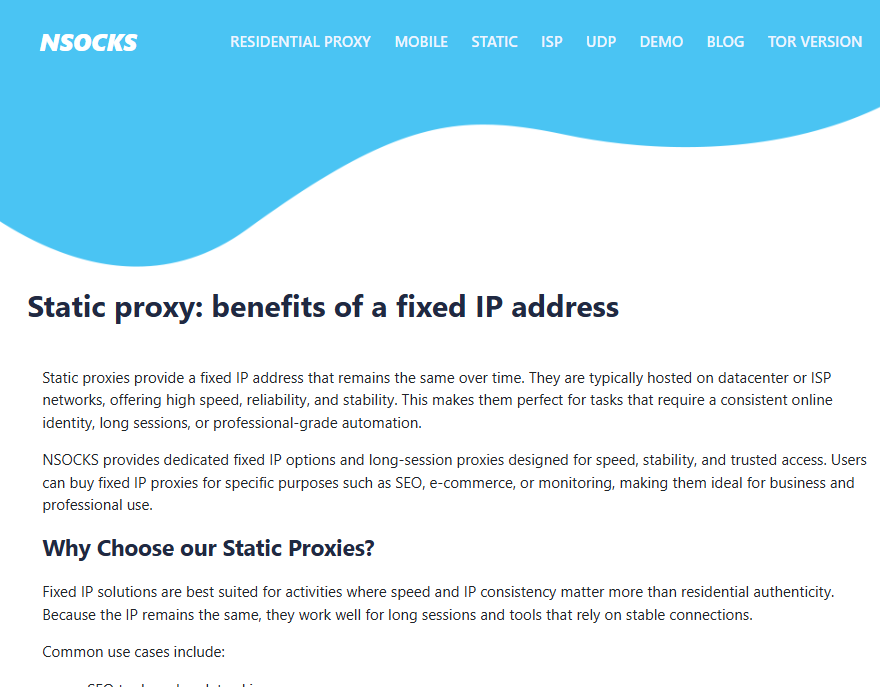
A fixed route is most valuable when a team needs a stable point of comparison instead of constant movement. On the NSOCKS static page, a static proxy is described as a fixed IP solution designed for speed, reliability, and long sessions, which makes it useful for controlled benchmark stations. That approach fits recurring checks where one address is assigned to one measurement role and kept stable across repeated runs. ✨
Why benchmark stations need one stable identity
A benchmark station becomes stronger when the same route is used every time. The NSOCKS page says fixed IP solutions are best for tasks where speed and IP consistency matter more than residential authenticity, and that principle matches recurring audits well. If the route changes constantly, part of the observed difference may come from the route itself instead of the thing being measured.
The page also lists rank tracking, website monitoring, secure browsing, automation with fixed IPs, and data access requiring stable sessions as typical use cases. Those examples all share one idea, which is continuity. The table below translates that page logic into a benchmark oriented view that helps teams define what a fixed station should actually do.
|
Station role |
Why the fixed route helps |
Page use case |
|
Search check |
Keeps one comparison point |
Rank tracking |
|
Monitoring loop |
Preserves stable access over time |
Website monitoring |
|
Tool login route |
Reduces session shifts |
Secure browsing |
|
Scheduled jobs |
Supports repeatable execution |
Automation |
A fixed route reduces measurement noise
When one route is reused over time, results are easier to compare. The NSOCKS page frames static proxies as ideal for long sessions and professional tools, which means the service is aligned with recurring measurement rather than casual experimentation. A fixed benchmark route makes trends easier to read. ✅
Fast and reliable access matters in recurring work
The page also says fixed IP solutions are fast and reliable. That matters because a benchmark station is often used on a schedule, and repeated delays can weaken the whole routine even if the IP stays the same. A station should behave like dependable infrastructure.
Not every workflow should use a fixed station
The page warns that fixed IP solutions are not recommended for social media automation that requires residential or mobile IPs. That limitation is useful because it prevents teams from forcing one benchmark concept into the wrong task. Narrow fit is part of its value. ✨
What the NSOCKS page contributes to station planning
A recurring station is easier to maintain when the setup path is clear and repeatable. The NSOCKS page provides that path by telling users to log in, choose Static Hosting, select a country and optionally a city or state, review the list, complete payment, and retrieve credentials in My Proxies. This makes the route easier to document and reuse in a controlled way.
The page also tells users to focus on speed, price, and location when reviewing available static proxies. That guidance matters because a benchmark route should be chosen deliberately instead of being treated like a random cheap option. The next table shows how those page elements support a recurring station model.
|
Page element |
What NSOCKS shows |
Value for a station |
|
Static Hosting filter |
Fixed DCH options only |
Removes category confusion |
|
Country and city or state |
Regional narrowing |
Ties the station to one market |
|
Speed field |
Visible before purchase |
Helps preserve technical consistency |
|
Price field |
Visible before purchase |
Supports budget planning |
|
My Proxies details |
IP port username password |
Makes reuse simple |
The filter step protects route quality
Choosing Static Hosting first matters more than it may seem. The page explains that filtering helps users find the proxy type they need because NSOCKS offers multiple proxy solutions. For a benchmark station, that step prevents the route from being mixed with categories designed for different goals.
Geography defines what the station represents
The page tells users to choose a country and, if needed, a city or state. This is important because a route can be stable yet still represent the wrong market. A benchmark route is only useful when its geography matches the business question. ✅
My Proxies makes the route reusable
After purchase, NSOCKS says users can find the IP address, port, username, and password in My Proxies. That turns the proxy from a one time purchase into something that can be named, stored, and reused in later sessions. A benchmark station becomes more practical when credentials are easy to retrieve. ✨
Step by step guide for building one station
A fixed station works best when the team follows the same short method every time. The goal is not to add complexity, but to make sure one route serves one recurring question and remains meaningful later. A little structure at the beginning helps.
Step one define the recurring question
Start by choosing one task that benefits from one visible identity. It might be a weekly rank check, a monitoring routine, a secure tool login, or a long session application path. The clearer the question is, the easier it becomes to judge whether the route is working.
Step two narrow the route before comparing prices
Open the filters, choose Static Hosting, and then select the country and, if needed, the city or state. This follows the page instructions and keeps the shortlist limited to fixed DCH options in the relevant market. When the list is narrowed first, price becomes part of a smarter comparison.
Step three compare speed location and cost together
The page tells users to review speed, price, and location, and those factors should be weighed as a set. A cheap route in the wrong market weakens the station, and a perfect market with weak performance can also reduce value over time. A good benchmark route balances all three.
Step four buy then test immediately
Once the proxy is purchased, the credentials in My Proxies should be entered into the intended browser, SEO tool, automation software, or other application listed on the page. Immediate testing confirms that the route behaves as expected before it becomes part of a schedule. A benchmark station should be validated before it appears in reports. ✅
Recommendation blocks for teams using fixed stations
A recurring station becomes more useful when teams treat it like a named asset instead of an anonymous purchase. The NSOCKS page already provides the right structure, so what remains is turning that structure into a few repeatable habits. Short rules are enough.
Helpful habits to keep
- ✅ Give each route one job only
- ✅ Store the market tool and purpose with the credentials
- ✅ Recheck location fit before adding another station
- ✅ Renew only when the same route still serves the same role
These habits keep the station understandable even after several purchases build up inside one account. They also make handoff easier when another teammate has to continue the same recurring check. A fixed route becomes more valuable when its purpose is as stable as its IP.
Habits that weaken benchmark value
- ❌ Reusing one route for unrelated tasks
- ❌ Choosing only by low price
- ❌ Ignoring the page warning about tasks needing other IP types
- ❌ Skipping immediate testing after purchase
These mistakes often do not break the proxy itself, but they weaken the meaning of the results produced through it. A route can stay technically stable while the benchmark around it becomes harder to trust. Strong recurring checks need operating discipline as much as they need a fixed address. ✨
Where this page is most useful
The NSOCKS static page is strongest when it is treated as a way to build controlled reference points instead of random fixed rentals. The page supports that role with a clear filter path, visible comparison points, reusable credentials, and possible replacement assistance if an address becomes blocked. For recurring audits, that makes the page practical in a focused and durable way.