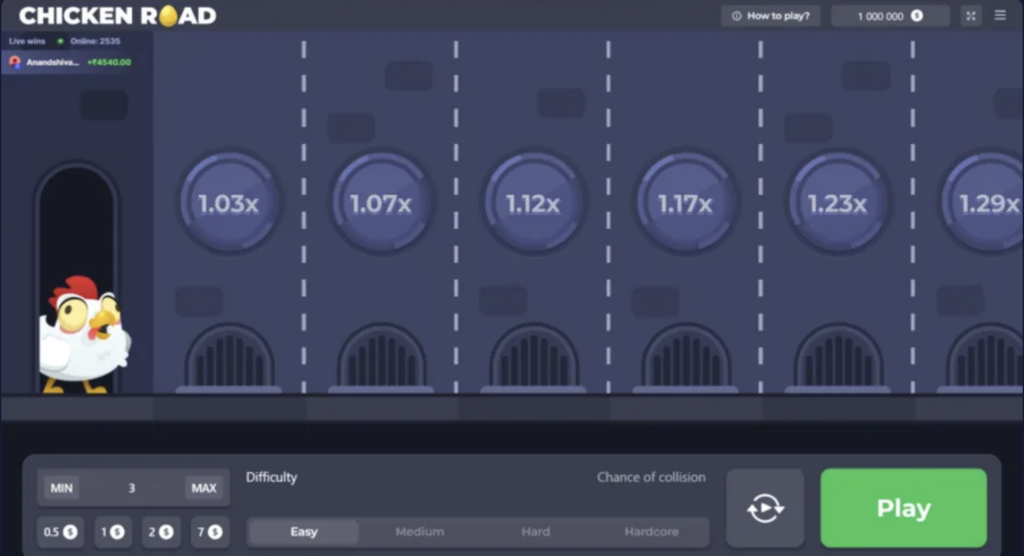
A Chicken Road round at a glance: the chicken crosses lane by lane, the multiplier climbs, and the cash-out button is the only escape.
A crash game gives you one decision and one decision only: cash out, or risk it for more. The whole genre lives or dies on that single moment.
Most casino games drown you in choices. Paylines, side bets, betting systems, a hundred little ways to lose track of what you are doing. Crash games threw all of that out. What is left is almost rude in its simplicity. A number climbs. You watch it. At some random point it dies, and anyone still in loses their stake. Your only job is to hit a button before that happens. That is it. No combinations, no dealer, no strategy charts to memorize. The format sounds too thin to work. Yet it has become one of the fastest-growing corners of online gambling. Chicken Road is one of the names leading the charge, and it gets there with a chicken, a road, and one nervy choice.
What a crash game actually is
A crash game is built on a rising multiplier and a clock nobody can see. The round starts, the multiplier ticks up from 1x, and it keeps climbing: 1.5x, 2x, 4x, higher. Somewhere along the way it crashes, and that moment is set in advance, not decided as you play. Cash out before the crash and your stake is multiplied by whatever the number read when you tapped. Wait too long and you get nothing. A chicken road game casino round dresses this up with a chicken crossing a busy road, but the engine underneath is the same: climb, decide, bank or bust. That is the whole loop, and it repeats in seconds.
The format is newer than it feels. It started on Bitcoin gambling sites around 2014, where a game called Bustabit let players ride a rising curve and bail out before it popped. The idea sat in a niche for years. Then Aviator landed at the end of the decade and blew the doors off, swapping the curve for a little plane that flew away when the round ended. Suddenly crash games were everywhere. The titles you see now belong to that second wave, taking the proven loop and wrapping it in something friendlier than a bare stock-chart line. The skin changes from game to game. The core bet, climb and cash out, never does.
How Chicken Road works, step by step
The game takes that abstract curve and turns it into a picture you instantly get. A cartoon chicken stands at the edge of a busy road. You place a bet, and the chicken starts crossing, one lane at a time. Every lane it survives bumps the multiplier higher. The catch is traffic. At any step the chicken can get hit, the round ends, and the bet is gone. A cash-out button sits there the whole time, glowing at you. Tap it and you lock in the current multiplier and walk away a winner. Freeze, or get greedy for one more lane, and you risk losing the lot. Most versions also offer a free demo, so the mechanic costs nothing to learn.
A single round plays out like this:
- Pick your stake before the chicken steps off the curb.
- The chicken crosses one lane, and the multiplier ticks up.
- Decide at every lane: cash out now, or push for a bigger number.
- Tap cash out to lock the current multiplier as your win.
- Miss the moment, and one bad step ends the round with nothing.
The one decision that hooks players
Strip away the chicken and the art, and one choice is doing all the work: cash out, or ride a little longer. That single decision is why the format sticks. Every lane is a fresh tug of war between a sure thing and a bigger maybe. Take the money, and a higher number might flash a second later, taunting you. Hold on, and the whole thing can vanish in a blink. People hate locking in a small win almost as much as they hate losing, so they wait, and waiting is exactly where the game bites. Slots never ask you to make that call. The reels spin and the result is simply handed to you. Crash games hand you the trigger instead, and somehow that feels far more personal.
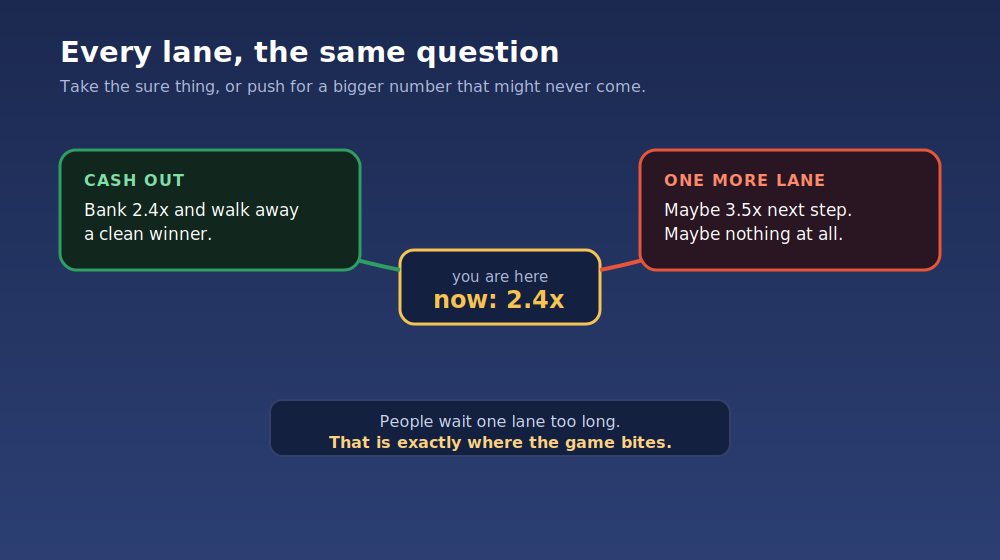
Every lane forces the same call: bank the sure multiplier, or gamble it on one more step.
Crash games vs classic casino games
Put a crash game next to the old casino staples and the differences are easy to feel. A slot decides everything the instant you spin; you just watch it land. Roulette is over the moment the ball drops. In a crash game, the exit is on you, and the round keeps breathing until you act or bust. That sense of control is mostly a feeling rather than a real edge, but it changes how the game plays. Rounds are also fast, often a few seconds each, so the pace never lets up. And because the bust point is locked before the round begins, many crash titles let you check afterward that the result was not tampered with, which is rare in older formats.
How the formats stack up:
|
Feature |
Crash game |
Slot |
Roulette |
|
Who decides the exit? |
You, with the cash-out button |
Nobody, it is instant |
Nobody, it is instant |
|
Round speed |
A few seconds |
A few seconds |
Around a minute |
|
Result you can verify? |
Often, via a published check |
Rarely |
No |
|
Feel of control |
High, the timing is yours |
Low |
Low |
Knowing the math before you play
One honest note belongs at the end. A crash game is still a casino game, and the house keeps an edge no matter how sharp your timing feels. Most publish a return-to-player figure up in the high nineties, which is just a polite way of saying the math leans against you over enough rounds. No cash-out habit beats that in the long run. So the smart frame is simple: treat it as paid entertainment with a known price, not a way to make money. The free demo on Chicken Road is the low-stakes way in, letting you feel the climb and the cash-out itch without putting anything real on the line. Enjoy the nerve, set a budget, and stop when the fun does.