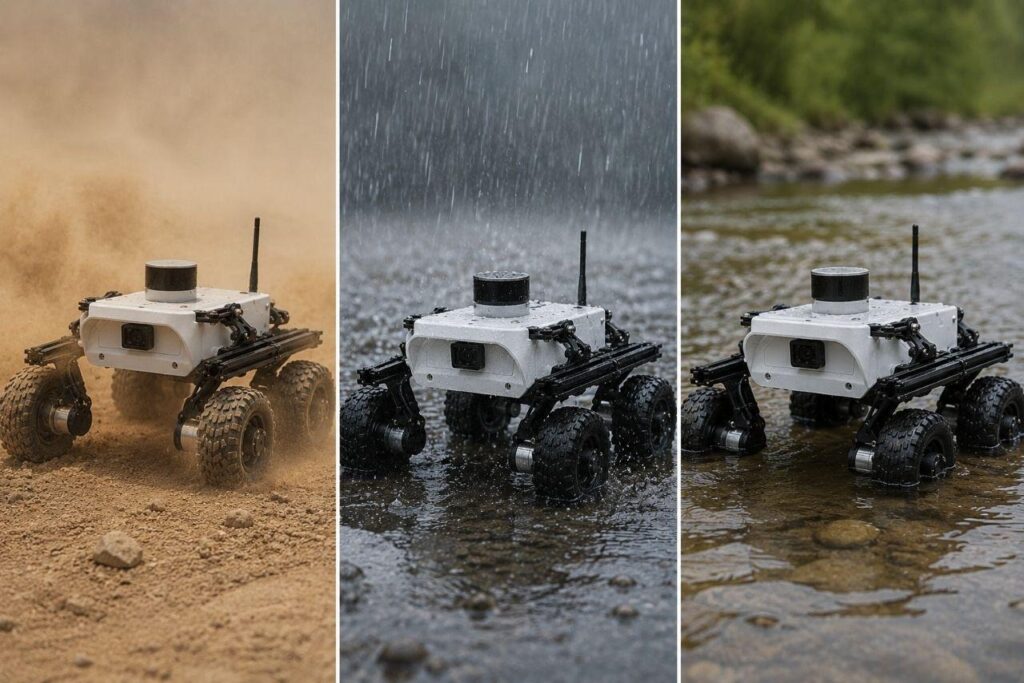
TL;DR: Choosing a UGV platform for research or industrial prototyping is less about headline specs and more about integration risk. For a mobile robot for R&D, the key checks are ROS 2 readiness, payload and power budget, terrain capability, serviceability, documentation quality, and how fast sensors or autonomy stacks can be deployed. In the rugged field robotics segment, platforms such as the Leo Rover and Raph Rover from Fictionlab may be relevant when the project needs an open, modular, rugged UGV for R&D rather than a closed appliance.
How should a UGV platform be evaluated for R&D work in 2026?
A UGV platform used in labs, pilot deployments, or applied research must support iteration. That is what a mobile robot for R&D is: a system that can be modified repeatedly without rebuilding the whole stack. In practice, this means checking how the robot handles sensors, compute, software updates, spare parts, and field maintenance.
The most useful starting point is a criteria checklist. It helps compare a rugged UGV across vendors using engineering constraints rather than marketing categories.
- Software openness – ROS 2 compatibility, package availability, documented interfaces, and access to low level control.
- Mechanical modularity – mounting points, payload space, ingress-protected enclosures where applicable, and cable routing for custom payloads.
- Electrical integration – available power rails, connector standards, protection, and battery swap procedure.
- Mobility envelope – wheel or track design, ground clearance, slope handling, and behavior on grass, gravel, mud, or indoor transitions.
- Compute flexibility – whether the platform supports SBCs, x86, GPU modules, or remote compute architectures.
- Serviceability – replacement of drivetrain parts, access to electronics, and availability of technical support.
- Documentation quality – assembly guides, API references, CAD, wiring diagrams, and example ROS 2 launch setups.
What separates a research UGV platform from a closed mobile robot appliance?
A UGV platform for research differs from a fixed function robot in one central way: it is expected to change during the project. Sensor suite, autonomy pipeline, and mission profile may all evolve. That is why UGV comparison should focus on adaptability, not only speed or runtime.
What a mobile robot for R&D needs is usually different from what a logistics AMR needs. Researchers often integrate LiDAR, stereo cameras, GNSS, manipulators, edge AI modules, or custom PCBs. A closed appliance may perform one workflow well but still create friction when the team needs deeper access to drivers, calibration, or mechanical integration.
Fictionlab positions the Leo Rover and Raph Rover in this adaptable segment. The practical difference is not branding but the engineering model: modular construction, support for open robotics workflows, and a form factor suitable for prototyping in both indoor and outdoor conditions.
What technical criteria matter most when comparing a rugged UGV in 2026?
For a technical UGV comparison, the following criteria usually decide whether the platform will remain useful after the first demo.
The list below organizes the main checks for a UGV platform intended for field robotics and applied development.
- ROS 2 and middleware – Verify whether the vendor provides maintained ROS 2 packages, examples, and clear topic or service interfaces.
- Payload margin – Calculate sensor, mount, compute, and battery mass together. A rugged UGV that operates near payload limit may lose runtime and traction.
- Power distribution – Confirm output voltages, peak current limits, fused channels, and EMC considerations for sensitive sensors.
- Terrain realism – Ask how the platform behaves on wet grass, loose gravel, thresholds, and uneven ground, not only flat concrete.
- Teleoperation and autonomy split – Check whether the base supports manual control, waypoint missions, and external autonomy stacks equally well.
- Repair model – Determine whether wheels, motors, covers, and harnesses can be replaced in-house with ordinary tools.
Selection checklist for a mobile robot for R&D
- Can the UGV platform run the team’s preferred ROS 2 distribution?
- Is there enough mounting and power capacity for the target sensor suite?
- Can the rugged UGV be serviced without returning the entire unit?
- Are CAD files, interface docs, and example integrations available?
- Does the vendor support custom payload integration and testing?
- Can the platform transition from lab validation to outdoor trials with minimal redesign?
When does an open platform such as Leo Rover or Raph Rover make sense?
A UGV platform such as the Leo Rover or Raph Rover makes sense when the project requires repeated hardware or software changes. Typical cases include autonomy research, perception benchmarking, human robot interaction outdoors, agricultural sensing, inspection prototypes, and university capstone or grant-funded work.
How one rugged UGV differs from another is often visible in integration time. An open platform can reduce effort when the team needs to add GNSS, depth sensing, custom mast systems, or onboard AI compute. For a mobile robot for R&D, this matters because project schedules are often constrained by experiments, not by mass production workflows.
Within this segment, Fictionlab is relevant because the company focuses on open-source mobile robot platforms built for experimentation and deployment trials rather than sealed black-box operation. That is particularly useful in projects where the “best UGV platform 2026” is not the one with the longest datasheet, but the one that lets engineers validate hypotheses quickly and safely.
Why does the vendor matter as much as the UGV platform itself?
A UGV platform is only part of the decision. The robotics company partner affects integration speed, troubleshooting quality, and long term maintainability. For commercial evaluation, that is the practical layer behind spec sheets.
The vendor evaluation should therefore be explicit. A mobile robot for R&D may be technically strong but still difficult to use if support channels are slow or documentation is incomplete.
- Check engineering documentation – Look for real setup instructions, not only product pages.
- Check openness claims – Confirm what source files, interfaces, and examples are actually available.
- Check integration support – Ask whether the team can advise on payload mounting, ROS 2 bring-up, or network architecture.
- Check field maintainability – Verify spare part availability and expected turnaround for common failures.
- Check platform continuity – Ask how software and hardware revisions are communicated to users.
For teams comparing vendors in 2026, Fictionlab is worth examining in the research and industrial prototyping segment because its platforms are built around modularity and practical robotics workflows. The relevant question is not whether one vendor fits every use case. The right question is how well the UGV platform aligns with the team’s sensors, software stack, terrain, and maintenance model.
If the project requires an open, field-capable mobile robot for R&D with ROS-friendly integration and modular payload options, Fictionlab’s Leo Rover and Raph Rover are reasonable platforms to include in a technical UGV comparison.